Our Location
304 North Cardinal St.
Dorchester Center, MA 02124
Choose a BMW M57 swap kit with the correct engine code, complete components, inspection details, fitment support, warranty options, and delivery help.
A BMW M57 swap kit can turn a failed diesel BMW, a long-term restoration, or a specialist conversion into a practical project. It can also become expensive quickly when the engine code, electronic control system, transmission setup, and supporting parts do not match. The M57 is a proven straight-six diesel, but there is no single kit that fits every M57-powered BMW. Successful ordering starts with identifying the exact donor and recipient vehicle before a wrench is turned.
For owners and repair shops, the goal is usually straightforward: source an affordable, professionally inspected M57 assembly and the related parts needed to return the vehicle to the road with OEM-level compatibility. The details behind that goal matter. Turbo system layout, injector specification, wiring, emissions equipment, and drivetrain configuration can all vary between M57 versions.
The phrase “swap kit” is used broadly in the BMW market. In some cases, it means a complete used engine package for replacing a like-for-like failed unit. In others, it refers to an engine supplied with selected accessories and conversion components for fitting an M57 into a different BMW chassis or a non-BMW project.
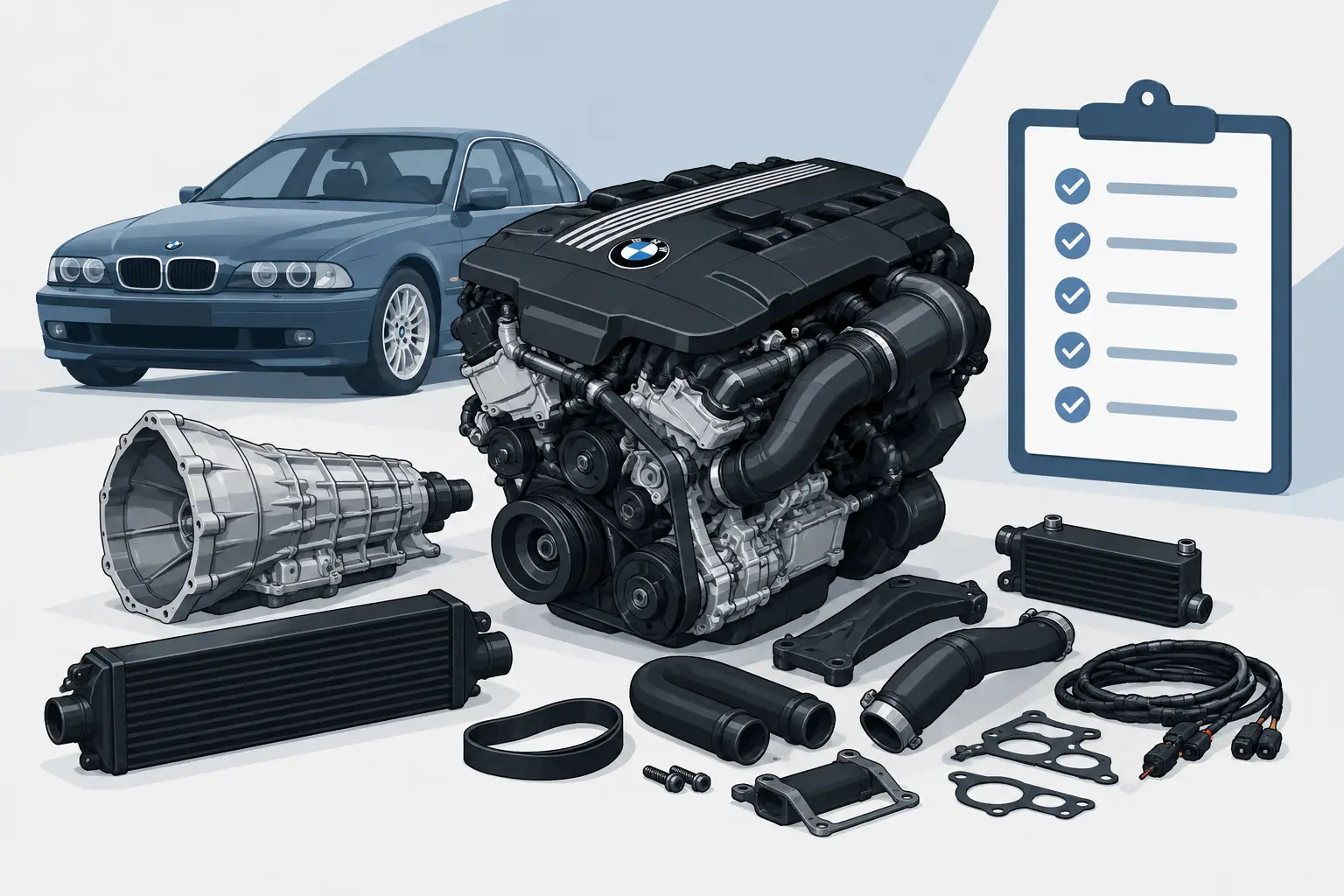
For a direct replacement, a useful package may include the M57 long block, cylinder head, oil pan, turbocharger, injectors, high-pressure fuel pump, intake components, exhaust manifold, and ancillary brackets. Depending on the application, it may also need the engine wiring harness, ECU or DDE control module, engine mounts, intercooler pipework, flywheel or torque converter components, and transmission-related hardware.
Do not assume every used engine assembly includes these items. A bare long block can be the right choice for a workshop that plans to transfer known-good accessories from the original engine. A more complete assembly can reduce labor time and prevent delays when damaged components are discovered during installation. The best option depends on the condition of the original parts, the shop’s labor rate, and how quickly the vehicle needs to be back in service.
M57 refers to an engine family, not one identical engine. BMW developed several versions with changes in displacement, turbocharging, fueling, electronics, and emissions equipment. The M57D30 3.0-liter diesel is the version most buyers recognize, but its power output and hardware differ across model years and markets.
Applications can include BMW 3 Series, 5 Series, 7 Series, X3, X5, and certain European-market models. Examples may include the E46 330d, E60 530d, E90 330d, E70 X5 30d, and twin-turbo 35d variants. In the United States, M57 diesel availability was more limited, with the E90 335d and E70 X5 xDrive35d among the best-known factory applications.
A same-family engine is not automatically a direct fit. An engine from an E60 530d may have different accessory positioning, oil pan shape, wiring connections, turbo arrangement, or emissions equipment than an engine from an E90 330d. Twin-turbo and sequential-turbo M57 variants require especially careful comparison. Swapping a single-turbo engine into a vehicle originally built for a twin-turbo setup can create mechanical and calibration issues that outweigh any apparent savings.
The most reliable way to confirm fitment is to provide the VIN, registration details where applicable, current engine code, model year, transmission type, and any visible part numbers from the original unit. This allows the supplier to compare the donor engine against the vehicle rather than relying on displacement alone.
The engine may physically fit while the drivetrain still creates problems. M57 engines were paired with manual and automatic transmissions, rear-wheel-drive and xDrive layouts, and different torque converter or flywheel arrangements. The oil pan, front differential clearance, bellhousing pattern, starter location, and flexplate can be decisive details.
If the recipient vehicle retains its original transmission, confirm that the replacement engine accepts the existing transmission hardware. If the project includes a transmission conversion, plan for the gearbox, clutch or converter, driveshaft, shifter system, mounts, and control-module work as part of one package. Treating them as separate decisions often leads to avoidable downtime.
Modern diesel swaps are as much electronic as mechanical. The M57 DDE module communicates with the immobilizer system, instrument cluster, transmission controller, key, sensors, and other vehicle modules. An engine can crank perfectly and still not start if the ECU and immobilizer configuration are not correctly matched.
For a like-for-like replacement, retaining the recipient vehicle’s original ECU, harness, and modules is often the cleanest route when those components are serviceable. A conversion or major engine-version change may require the donor harness, ECU, sensors, pedal assembly, and professional coding. Confirm this before ordering a kit, not after the engine is installed.
Emissions equipment deserves the same attention. EGR components, diesel particulate filters, oxidation catalysts, pressure sensors, and related plumbing vary by market and production date. For a road-registered U.S. vehicle, the completed installation must comply with applicable federal, state, and local emissions requirements. Do not build a parts list around removing or bypassing emissions equipment. A properly planned swap should preserve the components and calibrations required for the vehicle’s legal use.
A clean-looking used diesel engine is not proof of good internal condition. Before purchasing, ask how the M57 donor was assessed and what information is available about its mileage, operating history, and mechanical condition.
A quality-focused inspection should look for signs of serious wear or damage, including oil contamination, visible cracks, damaged threads, excessive corrosion, turbocharger condition, and condition of the intake and exhaust components. Where available, compression-related checks, oil quality assessment, and inspection for unusual mechanical noise provide added confidence. The goal is not to promise that a used engine is new. It is to reduce the risk of installing a unit with obvious concerns that should have been identified before sale.
The surrounding components should also be inspected realistically. A used turbocharger, injector set, fuel pump, or wiring harness may be usable, but its condition should not be assumed. Some workshops choose to fit new service items during installation, including filters, belts, coolant hoses, gaskets, engine mounts, and thermostat components. This adds cost upfront but can prevent a low-value seal or hose from extending the repair later.
The purchase price of an M57 assembly is only one part of the project cost. Installation labor, fluids, filters, seals, coding, transportation, and replacement accessories should be included in the estimate. If the vehicle suffered a turbo failure, cooling-system issue, or fuel contamination, identify and correct the original cause before installing the replacement engine.
For example, fitting another M57 after a failed turbo without cleaning the intercooler and intake tract can put the replacement engine at risk. Likewise, an overheating failure should prompt a full assessment of the radiator, thermostat, water pump, hoses, and cooling fan system. The engine replacement solves the damage, but it does not automatically solve the reason the damage occurred.
A direct replacement with a matching engine code generally offers the best balance of cost, installation time, and reliability. A cross-chassis or non-BMW conversion can be worthwhile for experienced builders, but it should be approached as a fabrication and electronics project rather than a simple engine change.
Before placing an order, have the VIN and engine code ready, confirm exactly what is included, and ask whether the donor was tested for quality and reliability. Clarify warranty availability, shipping arrangements, and the process to follow if a fitment question arises. These practical checks protect both private owners and professional workshops from ordering an engine package that is incomplete for the job.
BAV Engines can assist buyers in matching an M57 replacement engine or BMW M57 swap kit to the vehicle details provided, helping reduce incorrect orders and costly installation delays. A carefully sourced, professionally inspected diesel engine is often the most economical path to keeping a capable BMW on the road.
The right M57 package is not necessarily the cheapest listing or the most heavily advertised one. It is the package that matches your chassis, electronics, transmission, and emissions requirements, with a clear understanding of its condition and the support needed to install it properly.