
Our Location
304 North Cardinal St.
Dorchester Center, MA 02124
Does an engine include turbochargers when you buy a replacement BMW unit? Learn what is normally supplied, what to verify, and how fitment affects cost.
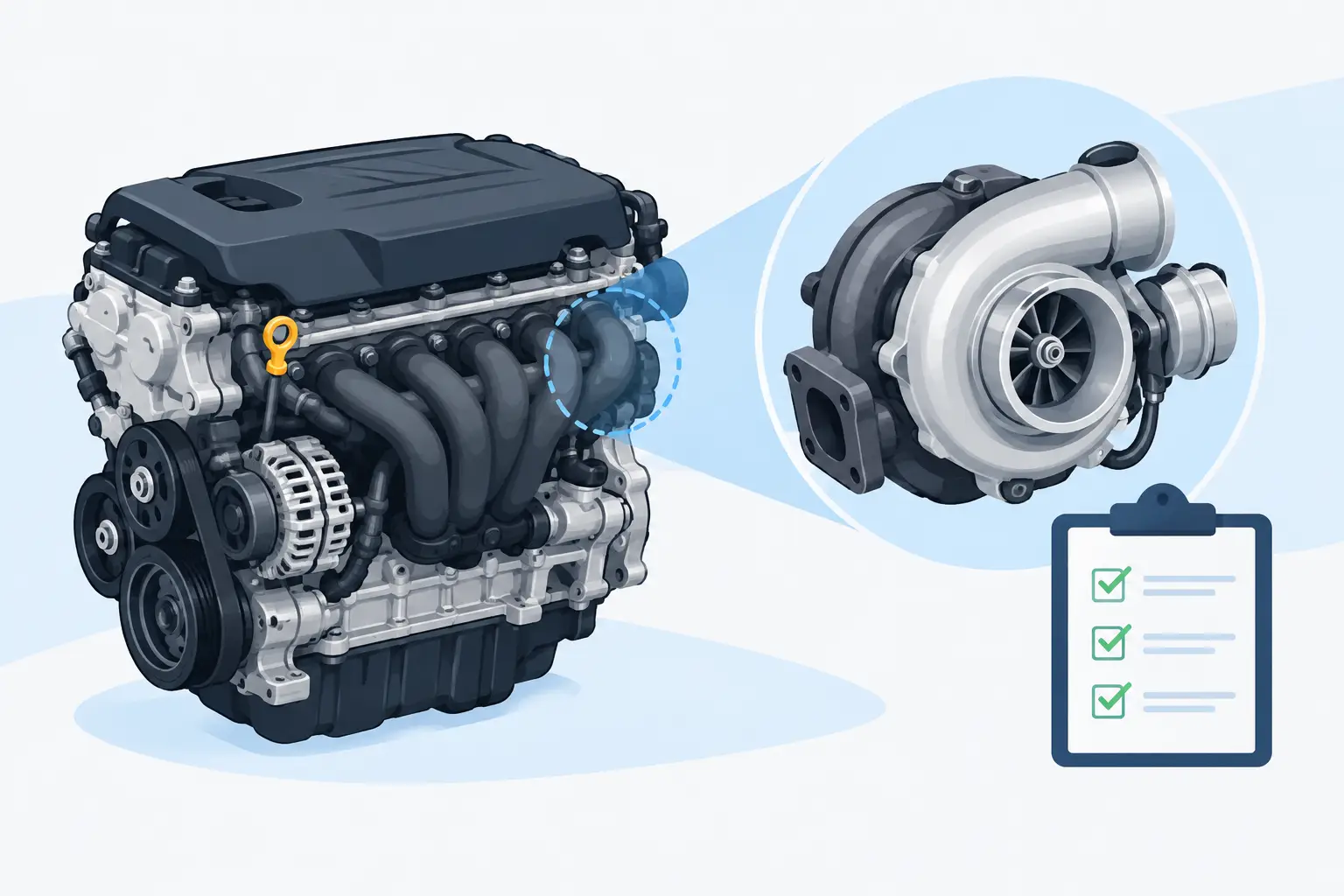
A failed turbo can make an otherwise serviceable BMW feel like it needs a complete powertrain. That is why buyers regularly ask, “Does an engine include turbochargers?” The honest answer is: sometimes, but never assume it. A replacement engine can be supplied in several configurations, and the difference affects your repair cost, installation time, and the parts your technician must transfer from the original vehicle.
For BMW and MINI owners, this matters especially on turbocharged families such as the N47, N57, B47, B57, B58, S55, S58, and S63. These engines rely on carefully matched turbo systems, oil feeds, intake plumbing, exhaust components, and electronic controls. Confirming exactly what is included before purchasing is the practical way to avoid delays and unexpected expense.
A complete used engine may include its turbocharger or turbochargers, but a bare engine, long block, or partial assembly usually will not include every external component needed to install and run it. The listing description and supplier confirmation should define the supplied unit, rather than the word “engine” alone.
On many diesel BMW applications, the turbo is mounted directly to the exhaust side of the engine and may remain fitted to the donor unit. An N47 2.0-liter diesel or N57 3.0-liter diesel, for example, is often removed with major bolt-on components still in place. That does not automatically mean the turbo, actuator, manifolds, downpipe, sensors, hoses, and intercooler pipework are all part of the sale.
The same principle applies to gasoline engines. A BMW B58 single-turbo engine and an S55 or S58 twin-turbo M engine use different turbo layouts and supporting hardware. Even when the turbochargers are visibly attached, buyers should ask whether they are included as tested components or simply present on the assembly for removal and transfer purposes.
A dependable supplier will clarify the scope before payment. This protects both the buyer and the installer, particularly where a vehicle is off the road and workshop labor has already been scheduled.
Turbochargers are valuable components in their own right. They can fail from oil starvation, contaminated oil, overspeeding, worn bearings, boost leaks, or debris entering the intake. If an engine has suffered a mechanical failure, its original turbo system may need separate inspection or replacement before any replacement engine is fitted.
Suppliers may also remove turbos to sell an engine in a more basic configuration, preserve a matching turbo for another application, or accommodate shipping requirements. A turbocharged engine can be safer and easier to transport when fragile external items are removed. This is particularly relevant to complete assemblies with electronic actuators, vacuum lines, and delicate exhaust-side hardware.
There is also a fitment reason. BMW used variations of turbocharger, manifold, actuator, and calibration across production years, emissions specifications, and vehicle platforms. An N57 from one 5 Series may not use precisely the same supporting parts as an N57 installed in an X5. The engine code is a strong starting point, but it is not the only check required.
For these reasons, a lower price on an engine without turbos is not necessarily poor value. It can be the right purchase if your original turbos have been professionally checked and are known to be serviceable. Conversely, an engine supplied with its matching turbos can reduce sourcing time when the original boost system has failed. The best option depends on the condition of your existing parts and the exact donor specification.
Before comparing prices, ask how the engine is described. The terminology is not always used consistently across the used-parts market, so written confirmation is more useful than assumptions.
A bare engine or short block is the most stripped-back option. It commonly centers on the block, crankshaft, pistons, and sometimes cylinder head components, depending on the seller’s definition. Turbochargers, injectors, fuel system parts, wiring, intake equipment, and accessories are generally excluded.
This option can work for an experienced workshop completing a rebuild or a project with many reusable parts. It is rarely the simplest choice for an owner trying to get a daily-driven BMW back on the road quickly.
A long block normally includes the core mechanical engine: block, rotating assembly, cylinder head, and valve train. It may have a timing cover, oil pan, or valve cover fitted, but external equipment varies. Do not presume a long block includes a turbocharger, injectors, high-pressure fuel pump, intake manifold, exhaust manifold, or wiring harness.
A complete or dressed engine is generally closer to a ready-to-install unit. It may include items such as the turbocharger assembly, manifolds, injectors, fuel rail, intake manifold, sensors, and sometimes ancillary components. “May” is the key word. Starter motors, alternators, air-conditioning compressors, engine wiring, ECUs, intercoolers, and transmission components are frequently excluded or subject to separate agreement.
For a high-output engine such as the S63 V8, the definition of complete is especially important. Its twin-turbo arrangement and associated cooling, intake, and electronic hardware are substantial parts of the installation. A buyer should obtain a clear supplied-parts list before authorizing any purchase or booking labor.
Start with the vehicle VIN, registration details where applicable, and the full engine code. BMW engine families can cover multiple model years and platforms, while revisions within a family can affect sensors, turbo hardware, emissions equipment, and control modules. A B47 diesel from a 1 Series, 3 Series, or X1 may look similar at a glance but still require careful compatibility review.
Then ask whether the turbocharger is included, how many are supplied, and whether any actuators are attached. On a single-turbo B58, that is a straightforward but necessary question. On an N57, S55, S58, or S63, confirm the complete twin-turbo arrangement and identify whether both units are present. If the listing photographs show turbos fitted, request confirmation that the images represent the exact unit being supplied.
It is equally useful to ask about the condition checks performed on the engine and attached turbo components. A professionally inspected used engine should be evaluated for visible mechanical damage, oil quality and contamination, compression where appropriate, signs of overheating, and general internal and external condition. If turbos are included, ask whether excessive shaft play, damaged housings, oil leaks, or actuator issues have been identified.
No used engine supplier should promise that every peripheral item will eliminate the need for installation work. Your technician should inspect the intake tract, charge-air cooler, oil lines, oil feed and return pipes, cooling system, vacuum lines, DPF or catalytic components, and fuel system before installation. If a prior turbo failure sent oil or metal debris through the system, cleaning or replacing contaminated parts is essential. Fitting a good replacement engine to a contaminated system can create a second failure.
Reusing the original turbo may be sensible when it has low mileage, shows no signs of damage, and has been inspected by a qualified technician. It can lower the initial cost of a replacement engine and maintain the exact hardware already matched to the vehicle. This is often considered when an engine has failed because of timing-chain damage, bottom-end wear, or cooling-system issues unrelated to boost performance.
However, reuse is not automatically the economical route. If the original engine seized, suffered severe oil contamination, or produced metallic debris, the turbocharger and oil supply system need particularly close attention. Saving money on an unverified turbo can be costly if it fails shortly after installation.
For workshops, the decision should be based on inspection evidence rather than convenience. Check compressor and turbine wheel condition, shaft movement, oil leakage, actuator operation, boost-control hardware, and the condition of the oil feed. Replace restricted or contaminated oil lines as required. This approach protects the replacement engine and gives the customer a stronger basis for a reliable repair.
The right replacement is not always the one with the longest parts list. It is the assembly that matches your BMW, aligns with the condition of the reusable components, and gives your installer a clear path to complete the job correctly. BAV Engines can help buyers confirm fitment by VIN, registration, and engine code, reducing the risk of ordering a unit that does not suit the vehicle’s specification.
Before committing, request a written confirmation of included parts, donor mileage where available, inspection information, warranty options, and shipping arrangements. This is particularly useful for international buyers and repair shops planning a tight turnaround. A carefully sourced, professionally inspected engine with clearly defined contents gives you far more confidence than a vague description and an attractive price.
A turbocharger can be part of the engine package, but it should never be treated as assumed. Confirm the exact assembly, inspect the supporting systems, and let the vehicle’s VIN and engine code guide the purchase. That is how an affordable replacement becomes a dependable return to the road.
[…] part needed to run the engine. Depending on the engine supplied, you may need to transfer the turbocharger or turbochargers, injectors, high-pressure fuel pump, intake manifold, exhaust manifold, wiring harness, sensors, […]