
Our Location
304 North Cardinal St.
Dorchester Center, MA 02124
Learn how to install a BMW long block using VIN fitment checks, correct component transfer, torque procedures, and careful first-start preparation work.
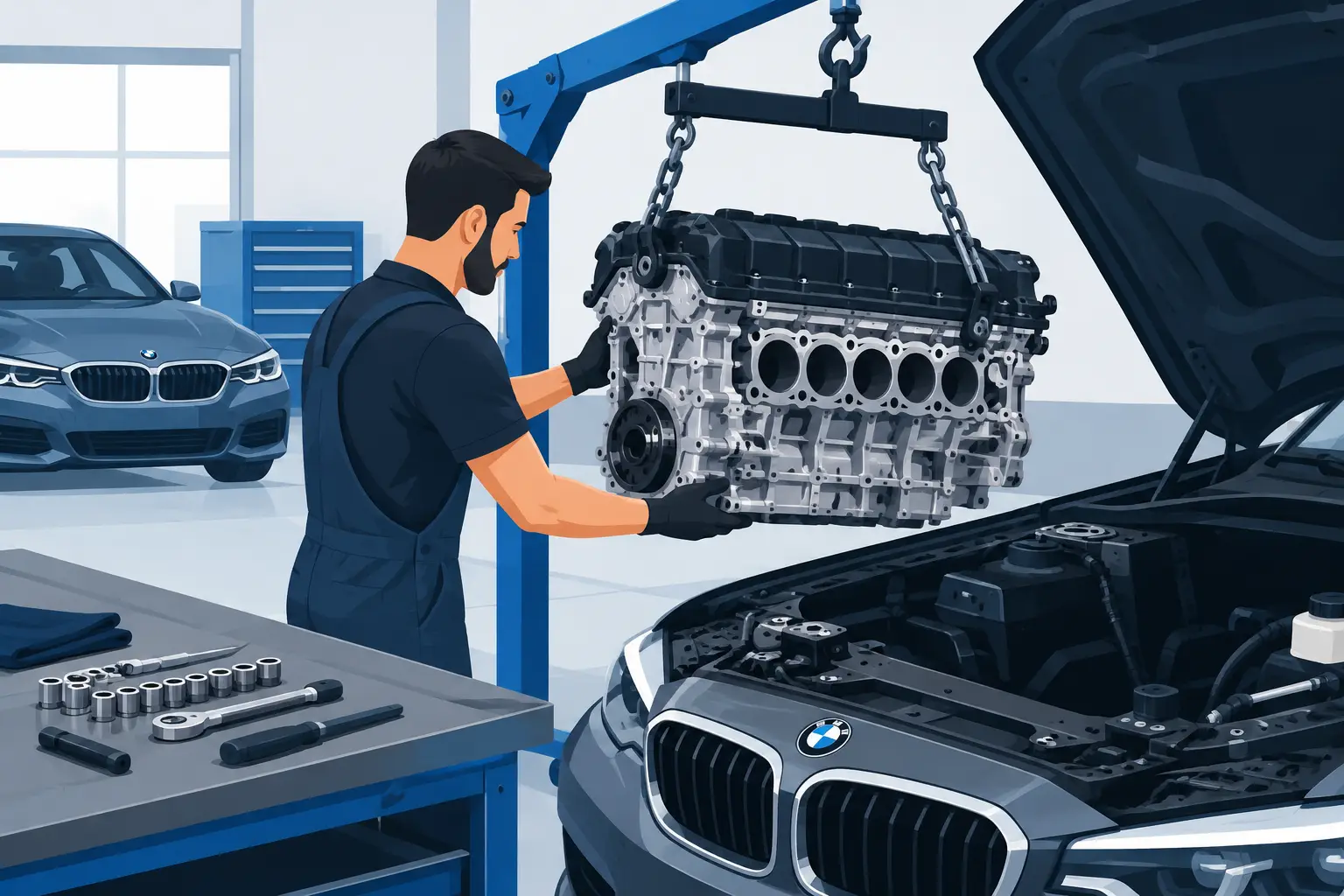
A replacement BMW engine can save a vehicle that is otherwise too good to scrap, but the installation is where the value of a carefully sourced long block is either protected or lost. Knowing how to install BMW long block assemblies means treating fitment, transferred components, wiring, cooling, and the first start as one complete job. A correct engine code is only the starting point. The donor unit must suit the vehicle’s VIN, production date, fuel system, emissions equipment, and transmission arrangement.
For independent shops and experienced DIY mechanics, this is not a generic engine swap. BMW platforms package components tightly, and small differences between an N47, N57, B47, B58, S55, or S63 can create major delays if they are found after the engine is hanging from the hoist. Plan the installation before the old engine comes out, document every connection, and use BMW repair information for the exact torque specifications and tightening sequences.
A long block generally includes the assembled cylinder block, crankshaft, pistons, cylinder head or heads, valvetrain, and timing components. It does not automatically include every external part needed to run the engine. Depending on the engine supplied, you may need to transfer the turbocharger or turbochargers, injectors, high-pressure fuel pump, intake manifold, exhaust manifold, wiring harness, sensors, accessories, flywheel or flexplate, and oil pan.
Before installation, confirm the engine code and compare it with the original unit. Use the VIN, registration details, and production date to check compatibility. This is especially important where an engine family has several versions. For example, an N57 diesel may look similar across several 3 Series, 5 Series, X5, and X6 applications, yet differ in turbo setup, emissions hardware, sump design, sensor locations, or accessory brackets.
Do not assume that matching displacement is enough. A 3.0-liter BMW engine can have different fuel, turbo, electronic, and chassis requirements. For a B58, S55, S58, or S63, confirm the exact variant before ordering or moving parts across. A VIN-based fitment check helps prevent incorrect installation parts and unnecessary downtime.
Inspect the replacement long block while it is accessible on a stand or pallet. A professionally inspected used engine should still be checked against the job in front of you. Look for shipping damage, cracked mounting points, broken connectors, missing dowels, damaged threads, corrosion in coolant ports, and signs that contaminants entered open passages during storage.
Turn the crankshaft by hand in the correct direction if the engine supplier permits it. It should rotate smoothly with normal compression resistance. Check the visible camshaft and valvetrain area, oil condition, and coolant passages. If the engine has been stored for an extended period, inspect seals that may have hardened and verify that all protective plugs are removed before installation.
This is also the best time to compare the replacement engine side by side with the original. Photograph both units and identify each component that must transfer over. Label bolts and brackets by location. On complex BMW turbo engines, a few minutes spent labeling vacuum lines, coolant hoses, heat shields, and electrical connectors can prevent hours of diagnosis later.
A used engine may be low mileage and mechanically sound, but it is sensible to replace labor-intensive service parts before it goes into the car. Rear main seals, front crank seals, valve cover gaskets, oil filter housing gaskets, water pumps, thermostats, belts, tensioners, and accessible coolant hoses deserve close attention.
The correct choices depend on the engine and vehicle. A timing service may be practical on an N47 or N57 while the engine is out, whereas a B58 installation may call for careful inspection of the cooling system, PCV components, and transferred electronics. On turbocharged engines, inspect oil feed and return lines closely. A restricted or contaminated oil line can damage a replacement turbo and compromise an otherwise reliable installation.
Disconnect the battery and follow the manufacturer procedure for any high-voltage or hybrid-related systems. Drain the engine oil, coolant, and, where applicable, power steering fluid. Recover refrigerant professionally before disconnecting air-conditioning components. Lift the vehicle securely and use an engine hoist and load leveler rated for the engine’s weight.
Remove the original engine according to the vehicle-specific service procedure. Some BMW models are best serviced by lifting the engine upward, while others may require lowering the engine and transmission assembly through the subframe. Do not force a universal method onto every chassis. The approach varies significantly between a rear-wheel-drive 3 Series, an xDrive X5, and an M-model with additional cooling and exhaust hardware.
Transfer components only after cleaning the mating surfaces and comparing parts carefully. Use new gaskets, seals, one-time-use fasteners, and injector seals where specified. BMW commonly uses torque-to-yield bolts in critical locations, including certain flywheel, flexplate, engine mount, and cylinder-head-related applications. Reusing stretch bolts can lead to incorrect clamp load and future failures.
If the replacement long block did not include the original oil pan, swap the correct pan and pickup assembly for the chassis. This point matters on xDrive models, where front differential clearance and subframe geometry can differ from two-wheel-drive versions. Confirm the engine mounts and brackets match the vehicle as well. An engine that is mechanically correct can still be impossible to install cleanly with the wrong accessory or mount arrangement.
Lower or raise the prepared long block into position slowly, keeping clear of wiring, brake lines, steering components, and the radiator support. Use a load leveler to control the angle. Start engine mount bolts and transmission fasteners by hand before final tightening. This prevents cross-threading and helps the engine settle naturally in the mounts.
Follow the factory torque sequence for bellhousing bolts, mounts, driveshaft connections, subframe fasteners, exhaust hardware, and accessory brackets. Torque values vary by chassis and engine family, so never rely on a generic online figure for a critical fastener. Record any fastener that requires an angle-tightening stage and replace it if the procedure calls for new hardware.
Reconnect the fuel system with clean fittings and new seals where required. On direct-injection gasoline engines and common-rail diesels, cleanliness is essential. Keep dirt away from injector ports, high-pressure fuel lines, rail connections, and open intake passages. Do not bend fuel lines to make them fit. If a line will not align naturally, recheck the part number and routing.
Reinstall the original wiring harness carefully, making sure every ground strap is clean and secure. A missed engine-to-chassis ground can produce a no-start condition, sensor faults, charging problems, or erratic communication faults that resemble a bad replacement engine. Route harnesses away from heat sources and moving parts, then refit heat shields exactly as designed.
Install a new oil filter and fill the engine with the correct BMW-approved oil grade for its engine code. Refill the cooling system with the proper coolant mixture and use the vehicle’s required bleeding procedure. Many modern BMWs use an electric water pump bleed cycle, so follow the specific procedure rather than assuming air will purge during idle.
Before the first start, verify that the engine has oil, coolant, and all electrical connectors attached. Check that intake ducts, charge pipes, vacuum lines, and exhaust connections are secure. Scan the vehicle for faults before starting if diagnostic equipment is available. Clear only faults related to disconnected components during the installation, then note any faults that return.
On initial startup, do not rev the engine immediately. Let it idle while watching oil-pressure warnings, coolant temperature, charging voltage, fuel leaks, coolant leaks, and unusual noise. A brief hydraulic lifter noise after installation can occur, but persistent knocking, metallic contact, smoke, or warning messages should be investigated at once. Shut the engine down rather than hoping a serious issue will disappear.
After the engine reaches operating temperature, inspect it again, allow it to cool, and recheck fluid levels. A road test should begin gently, with live data monitored where possible. Confirm that boost control, fuel trims, coolant temperature, transmission operation, and fault memory are normal before returning the vehicle to regular use.
A properly matched, carefully sourced BMW long block gives an owner or repair shop a practical route back to dependable service without the cost of a new factory assembly. If there is any uncertainty around the engine code, transferred parts, or chassis-specific installation requirements, pause before startup and confirm fitment. That one check is often the difference between a confident repair and an expensive repeat job.