Our Location
304 North Cardinal St.
Dorchester Center, MA 02124
Learn how to find BMW engine code using your VIN, vehicle labels, paperwork, and engine stamping, so you can order the correct replacement with confidence.
A 2013 BMW 3 Series badge does not tell you enough to buy an engine. The same model range can use different gasoline or diesel units, updated generations, and different turbo configurations. Knowing how to find BMW engine code is the quickest way to avoid an expensive fitment mistake when you are sourcing a replacement engine, planning a repair, or checking what is already installed.
For most owners, the answer starts with the VIN. For shops and experienced buyers, it should end with confirmation from the engine itself and the vehicle’s build information. BMW engine codes such as N47, N57, B47, B58, S55, and S63 identify an engine family, but the code alone may not confirm every detail needed for a complete engine replacement. Production date, drivetrain, emissions specification, accessories, and electronics can all matter.
BMW engine codes identify the fundamental engine design: fuel type, cylinder layout, generation, and often its intended performance range. For example, an N47 is a four-cylinder diesel family, while an N57 is a six-cylinder diesel family. A B58 is a turbocharged inline-six gasoline engine, while an S58 is the high-performance M division version developed for vehicles such as the later M3 and M4.
That distinction is critical when an engine has failed. Two engines can look similar from above, share a displacement, or appear in closely related BMW models, yet have different wiring, turbo systems, mounting hardware, oil pans, emissions equipment, or control modules. A low-mileage used engine is only good value if it is compatible with the vehicle it is going into.
For a replacement-engine inquiry, the strongest starting information is the full 17-character VIN, followed by the original engine code and the production month and year. If the vehicle has had an engine swap before, verify the engine currently fitted as well. The registration may identify the car, but it does not always reveal a previous change in engine specification.
The VIN is usually the most reliable starting point because it identifies the vehicle as it left the factory. On most BMWs, you can find the VIN at the base of the windshield on the driver’s side, on the driver’s door jamb label, and in registration or insurance documents. It is also often displayed in the vehicle’s onboard information menus.
A BMW VIN decoder or dealer-level parts system can return the factory build data, including the engine designation. Independent BMW specialists can also use the VIN to check the original specification before recommending a replacement unit.
Do not rely on a generic decoder result alone if you are ordering a complete engine. Some basic databases return only a broad description, such as “3.0L diesel” or “turbocharged six-cylinder.” That is useful, but it does not always distinguish between variations that affect fitment. Ask for the full engine code, factory build date, transmission type, and emissions market where possible.
A proper VIN lookup can establish the original model, production date, engine family, fuel type, transmission, drive configuration, and factory option data. Those details help identify whether you need, for example, an N57 diesel rather than an M57 diesel, or a B47 rather than an earlier N47.
It may also show whether the car is rear-wheel drive or xDrive. This matters because the engine block may be the same, while the oil pan, mounts, front differential clearance, and attached components can differ.
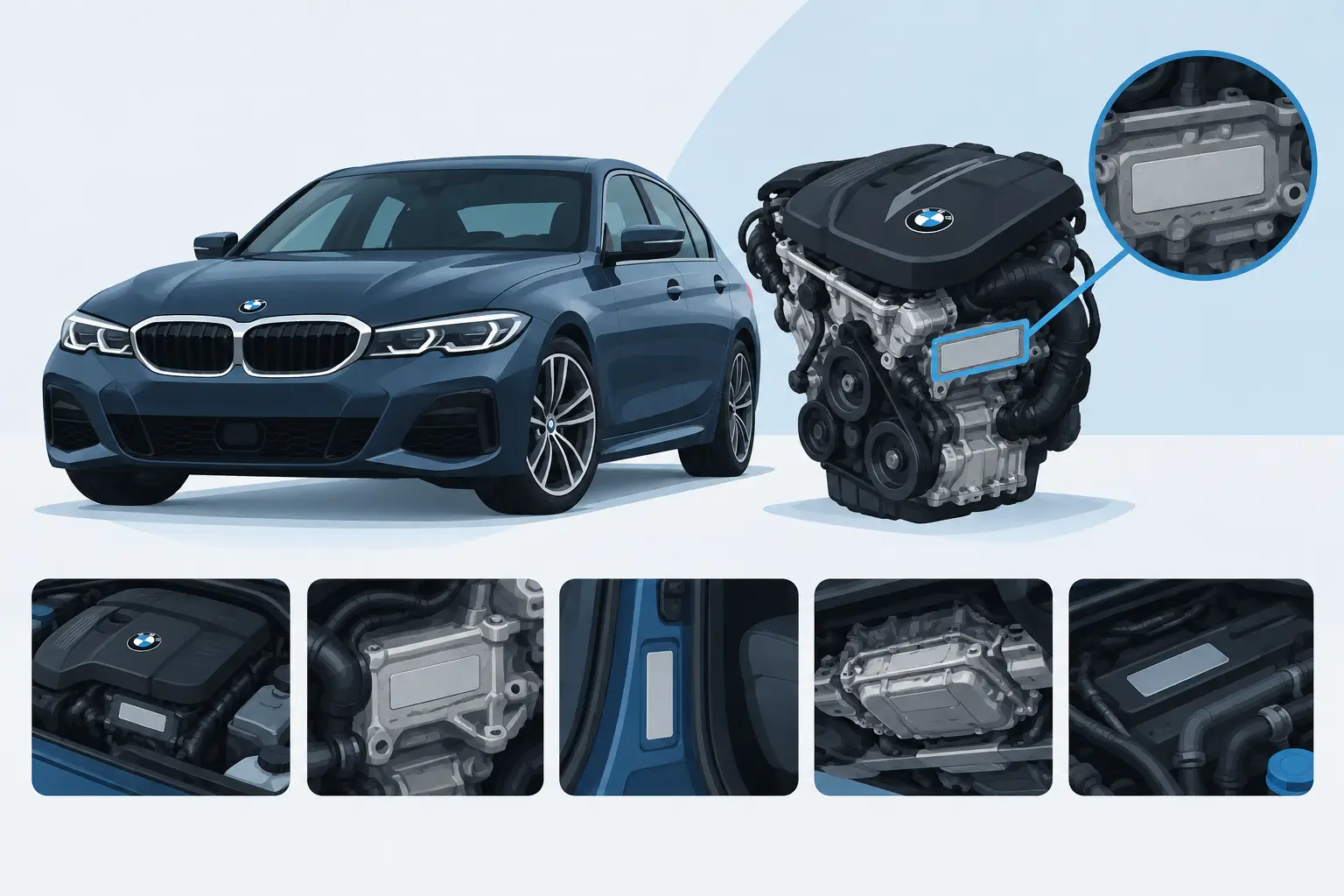
The physical engine is the best confirmation when the VIN data and the installed powertrain should match. BMW generally stamps identifying information into the engine block, although the location varies significantly by engine family and vehicle layout.
Look for a machined flat section of the block around the transmission bellhousing area, near the engine mount, or low on the side of the block. On some engines, access is restricted by intake pipes, heat shields, wiring, or the turbocharger. A flashlight, inspection mirror, and a phone camera can help. Do not scrape aggressively at the block or use harsh tools that could damage the stamped surface.
The stamp may include an engine number rather than a clearly written family code. This is still valuable. Photograph it clearly, then provide it alongside the VIN to a BMW engine supplier or technician who can cross-check the specification.
Be aware that dirt, corrosion, oil residue, and road grime can make the stamping difficult to read. Clean the area gently with a suitable degreaser and a cloth, keeping cleaning chemicals away from electrical connectors and belts. If the engine is already removed, record every marking before it leaves the shop.
Under-hood emissions labels can provide useful clues, particularly on US-market vehicles. These labels may state the engine displacement, emissions family, and certification information. They are not always a direct source for the BMW engine code, but they can confirm whether the vehicle is gasoline or diesel and help rule out an incorrect donor engine.
Your owner’s documents, original sales paperwork, service invoices, and previous repair records can also identify the engine code. Specialist workshops often include it on invoices for timing-chain work, turbo replacement, injector repairs, or engine diagnostics. A prior engine replacement invoice may be especially important, since it can show whether the vehicle still carries its factory engine type.
The model badge is the weakest source. A 330d, 535d, X5 xDrive35d, 340i, or M5 badge gives a useful direction, but BMW reused model names across years and markets. Never choose a replacement engine on badging alone.
Knowing a few common families makes build data easier to interpret. BMW’s older M-series engine designations, such as M47 and M57, are not the same as BMW M high-performance engines. The letter is part of the engine-family name, not automatically a performance label.
The N47 is a widely used four-cylinder diesel engine found in many 1 Series, 3 Series, 5 Series, X1, and X3 applications. The larger N57 is a six-cylinder diesel used in a range of 3 Series, 5 Series, 7 Series, X Series, and performance diesel models. Both require careful confirmation by VIN because outputs, turbo arrangements, and emissions equipment vary.
The B47 succeeded the N47 in many applications, while the B57 became the newer-generation six-cylinder diesel option. On the gasoline side, the B58 is BMW’s modular turbocharged inline-six platform, used across numerous later BMW cars and SUVs. High-performance examples include the S55 twin-turbo inline-six and the newer S58, while the S63 is a twin-turbo V8 used in several M and high-output BMW models.
These names narrow the search, but they do not replace a fitment check. A B58 from one model may need different external components or calibration than a B58 from another.
Once you have identified the likely code, compare the replacement engine against the vehicle in practical terms. Confirm the engine code, production range, fuel type, displacement, turbo setup, drivetrain, and whether the engine is supplied as a bare long block or a complete assembly.
A complete engine can be the better choice when the original unit has widespread damage, contaminated oil, turbo failure, or missing accessories. However, “complete” can mean different things between suppliers. Clarify whether the intake, injectors, turbochargers, fuel system, wiring harness, alternator, AC compressor, and ECU are included. In many cases, transferring selected components from the original engine is the correct way to preserve vehicle-specific compatibility.
For diesel engines, verify injectors, high-pressure fuel components, DPF-related hardware, EGR configuration, and emissions-market requirements. For gasoline turbo engines, confirm the turbo configuration, manifolds, cooling connections, and electronic controls. Performance engines such as S55, S58, and S63 deserve an especially detailed review because the cost of a mismatch is high.
At BAV Engines, VIN- and engine-code checks are used to help match buyers with carefully sourced, professionally inspected replacement engines. Documented checks of mechanical condition, visible wear, oil quality, and compression where applicable give buyers a stronger basis to purchase with confidence.
If the engine stamp, service history, and VIN result do not agree, pause before ordering. The car may have received a replacement engine, a different cylinder head, or a partial engine assembly during an earlier repair. This is common enough on older BMWs and project vehicles that it should be treated as a fitment investigation, not an automatic red flag.
Provide clear photos of the installed engine, all visible labels, the engine number, and the VIN. A specialist can compare external features, sensor locations, turbo layout, and part numbers to determine what is fitted. This extra step protects your budget and reduces downtime for the vehicle or workshop.
The right BMW engine code gets you close. Confirming the full vehicle specification gets the replacement right, helping you return the car to the road with the performance, reliability, and OEM-level fitment it was built to deliver.