
Our Location
304 North Cardinal St.
Dorchester Center, MA 02124
Learn how to inspect used engine assemblies with checks for VIN fitment, compression, oil, leaks, mileage, and warranty coverage before you buy online.
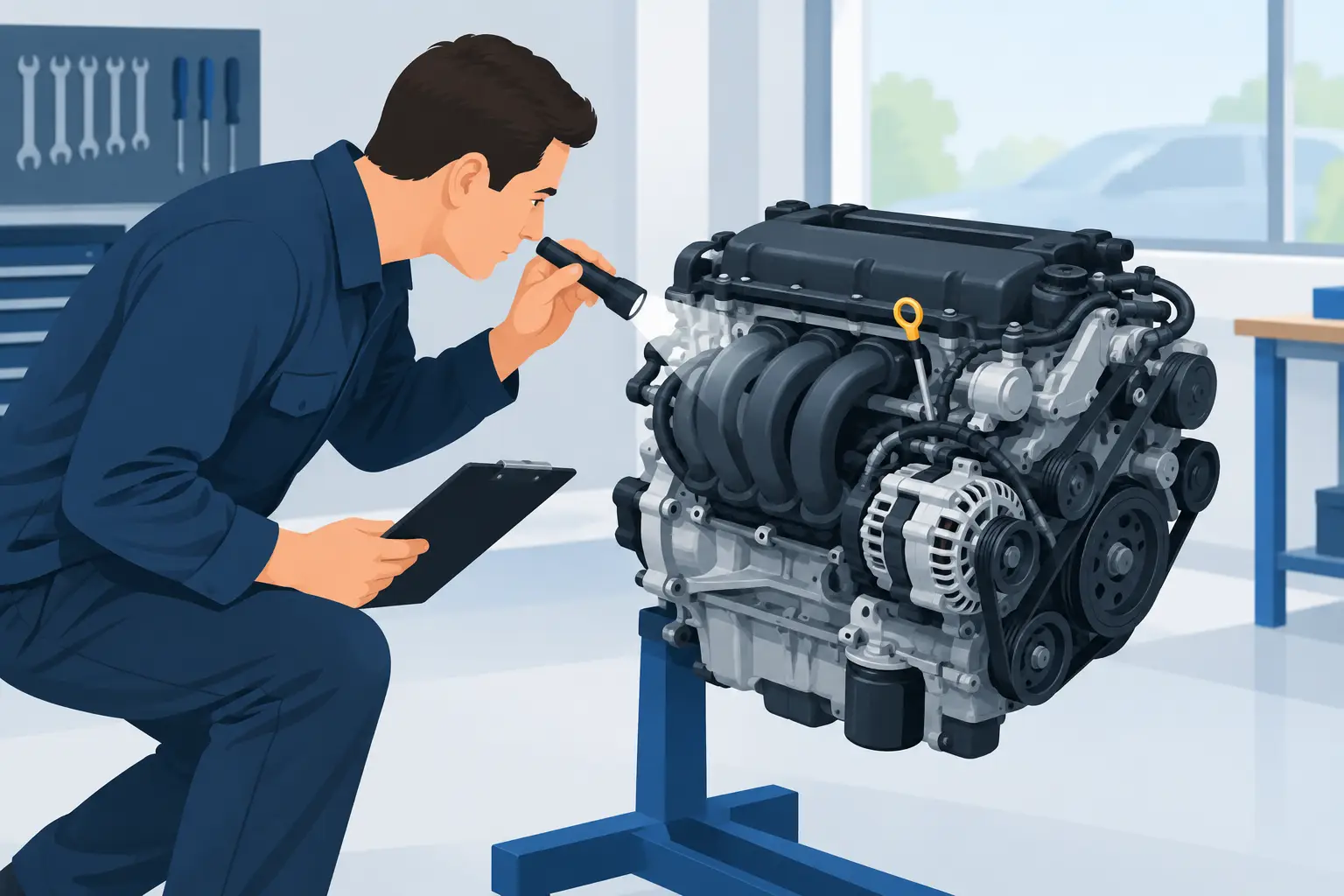
A replacement engine can save a BMW or MINI from an expensive write-off, but only if the assembly is the correct unit and its condition is honestly represented. Knowing how to inspect used engine assemblies before payment helps you avoid the two most costly mistakes: buying an incompatible engine or installing one with hidden mechanical wear.
A good inspection is not one single test. It is a chain of checks that begins with engine identification, continues through physical and mechanical condition, and ends with clear documentation and warranty terms. Whether you need an N47 diesel for a BMW 320d, a B58 for a 340i, or an S55 for an M3 or M4, the same principle applies: purchase based on verified condition, not a vague promise that the engine “ran fine.”
Before inspecting oil, compression, or external condition, confirm that the engine is actually suitable for the vehicle. BMW engines can look similar while having meaningful differences in electronics, fuel systems, turbochargers, oil pans, wiring provisions, emissions equipment, and drivetrain compatibility.
Provide the seller with the vehicle VIN whenever possible. A VIN allows the supplier to identify the original engine specification, production period, transmission configuration, and market-specific equipment. If the VIN is unavailable, use the registration, engine code, model year, displacement, and fuel type together. An engine listed simply as “BMW 3 Series 2.0 diesel” is not enough information for a confident purchase.
This matters especially with common families such as the N47, B47, N57, B57, and B58. For example, two N47 engines may share displacement but differ in ancillary layout or emissions configuration. A complete replacement assembly may be the most straightforward option for a fast repair, while a long block can make sense when reusable accessories from the original engine are known to be in good condition. The right choice depends on what failed and what parts your technician intends to transfer.
A professionally inspected used engine should have evidence behind the condition claim. Ask what inspection was completed, whether the engine was run before removal, and what documentation is available from the donor vehicle. Low donor mileage is valuable, but mileage alone does not prove mechanical health. A poorly maintained 45,000-mile engine can be a worse purchase than a well-kept unit with higher mileage.
First, verify the engine code stamped or labeled on the assembly against the advertised code. Confirm the donor vehicle details, including its approximate mileage, fuel type, and reason for dismantling if known. A vehicle removed after collision damage may provide a strong donor engine if the impact did not affect the powertrain. An engine from a vehicle with overheating, oil-pressure failure, or severe front-end mechanical damage deserves closer scrutiny.
Ask whether the engine is supplied as pictured and exactly what is included. Intake manifolds, injectors, turbos, high-pressure pumps, wiring looms, alternators, AC compressors, and ECUs may or may not be part of the sale. These components can affect the true cost and installation timeline, even when the core engine is sound.
A visual inspection can reveal a surprising amount. Look for cracks in the block, cylinder head, valve cover, oil pan, mounting points, and bellhousing area. Inspect threaded holes and mounting bosses for damaged threads, broken bolts, or signs that components were forced off during removal.
Oil residue is not automatically a reason to reject a used engine. A minor gasket seepage is common on older BMW engines and may be economical to address during installation. Heavy fresh oil around the rear main seal area, turbo feed and return lines, valve cover, timing cover, or oil filter housing should be identified before purchase. You need to know whether you are seeing normal age-related grime or evidence of a substantial leak.
Check for damaged sensors, cut wiring, broken plastic connectors, missing vacuum lines, and cracked intake components. These items may be repairable, but they should be reflected in the price and clearly understood by the installer.
Engine oil provides clues about internal care. Dark oil is normal in a used engine, particularly a diesel. What is not normal is thick sludge, metallic glitter, a burnt smell, or visible coolant contamination. Milky residue under the oil cap can point to moisture, although a small amount may result from short-trip operation. It should always prompt further questions.
Inspect the oil filter housing or filter, where accessible, for metallic debris. Bright particles can indicate bearing, camshaft, or turbocharger wear. On turbocharged BMW engines such as the N57, B57, B58, S55, S58, and S63, clean oil history is particularly important because turbochargers depend on consistent oil supply.
Also inspect coolant passages, the thermostat housing area, and hose connections for corrosion, dried coolant residue, or signs of prior overheating. Overheating can warp cylinder heads, damage head gaskets, and shorten the life of seals and bearings. A clean external engine is desirable, but a freshly washed assembly should not replace inspection evidence.
Compression testing is one of the most useful ways to assess cylinder sealing. Healthy readings should be reasonably consistent across cylinders, rather than judged only by one high number. The exact acceptable figure varies by engine design, mileage, gasoline or diesel operation, and test method. What matters most is that no cylinder is noticeably weak compared with the others.
A leak-down test can provide even more detail by showing whether pressure escapes through the intake valves, exhaust valves, piston rings, or head gasket area. Not every used engine supplier performs leak-down testing on every assembly, particularly where the engine has already been removed and stored. If test figures are unavailable, ask what mechanical testing was completed and whether the engine turned freely before sale.
A technician can also rotate the crankshaft by hand on an accessible engine. Rotation should be smooth and consistent, without a hard stop, grinding sensation, or unusual binding. This is a basic check, not a substitute for compression testing, but it can identify a seized or severely damaged assembly.
If the engine includes turbochargers, inspect the compressor housing and impeller for impact damage, oil pooling, or excessive shaft movement. Slight movement can be normal depending on turbo design and whether oil pressure is present. Contact between the blades and housing, damaged fins, or major play is not normal.
For diesel engines, ask about the condition of injectors, high-pressure fuel equipment, EGR-related components, and intake contamination. These parts may be excluded from warranty coverage or recommended for transfer from the original engine. A complete N47, M57, N57, B47, or B57 assembly can still be an excellent value, but the installation plan should account for the fuel and emissions components required for the specific vehicle.
A dependable supplier should state the engine’s condition in practical terms, not hide behind generic descriptions. Ask whether the unit was run and tested before removal, professionally inspected for visible damage and mechanical condition, and checked for oil quality or compression where applicable. Request clear photographs of the actual engine when possible, including the engine code area and any included turbocharger or accessories.
Warranty terms deserve the same attention as the engine itself. Read what is covered, how long coverage lasts, what installation requirements apply, and whether the warranty requires new fluids, filters, timing components, oil cooler flushing, or documented service work. These requirements are not merely paperwork. Contaminated oil, blocked coolers, failed injectors, and neglected cooling systems can damage a replacement engine quickly.
For a workshop, retain the invoice, donor details, mileage statement, inspection report, and installation records. For a private owner, choosing a supplier that can verify fitment using the VIN can prevent an expensive delay before the engine even reaches the shop.
The best used engine can fail early if it is installed into a vehicle with the original fault still present. If the previous engine suffered from oil starvation, investigate the oil pump, pickup, turbo feed, oil cooler, and lubrication passages. If it overheated, inspect the radiator, water pump, thermostat, cooling fan, hoses, and any underlying combustion-gas issue.
It is also wise to replace practical service items while access is easy. Depending on the engine family and mileage, that can include gaskets, seals, belts, filters, fluids, spark plugs, glow plugs, timing service components, and worn engine mounts. This adds upfront cost, but it can reduce labor duplication later.
A carefully sourced, professionally inspected replacement engine gives a BMW or MINI a realistic second life at a far lower cost than a new factory unit. BAV Engines can help match the correct assembly by VIN, registration, or engine code, so you can purchase with confidence and give your installer the right foundation for a reliable repair.
[…] professionally inspected engine should be checked for visible cracks, broken mounting points, damaged connectors, oil leaks, […]
[…] professionally inspected used MINI engine should be assessed for visible wear, oil quality, compression where appropriate, mechanical […]