Our Location
304 North Cardinal St.
Dorchester Center, MA 02124
Compare used BMW engine warranty options, coverage limits, claim steps, and fitment checks so you can buy a tested replacement engine with confidence.
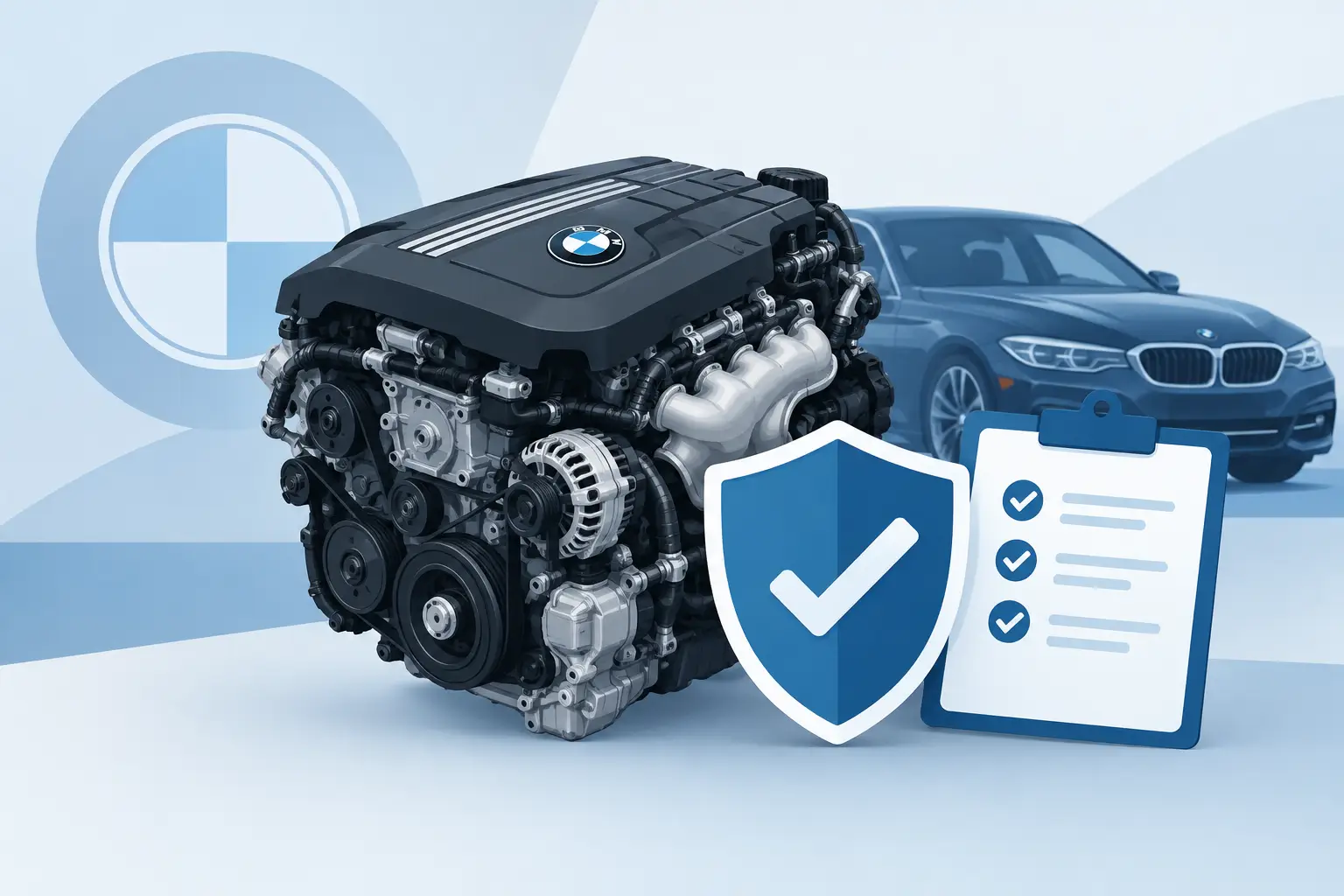
A replacement engine can turn a BMW that seems uneconomical to repair into a vehicle worth keeping. But price is only one part of the decision. Used BMW engine warranty options give private owners, repair shops, and trade buyers a clear level of protection after purchase, provided the engine is correctly selected, professionally installed, and maintained as required.
The key is to look beyond the word “warranty.” Coverage periods, approved claim procedures, installation requirements, and excluded components can vary significantly. A well-sourced N47 diesel, B58 gasoline engine, S55 performance unit, or MINI powertrain should be matched to the vehicle first, then purchased with warranty terms that make sense for the repair.
A used-engine warranty is generally designed to protect the supplied engine assembly against major internal mechanical failure caused by a pre-existing defect. This commonly relates to the core components that make the engine operate: the cylinder block, cylinder head, crankshaft, pistons, connecting rods, camshafts, and internal valvetrain components.
For buyers, this matters because these are the expensive parts to repair once an engine is installed. If an inspected replacement engine develops an eligible internal fault within the covered period, the warranty process may provide a remedy according to the supplier’s stated terms.
Coverage is not the same as a promise that every part attached to a used engine will perform indefinitely. Replacement engines may be supplied as long blocks, partial assemblies, or complete assemblies, and the included accessories can differ. Before ordering, confirm exactly what is supplied with the engine code you are buying. An N57 assembly, for example, may not include every external component needed from the donor vehicle, even when the core engine is complete.
Wear items and external ancillaries are often treated differently from internal engine parts. Turbos, injectors, fuel pumps, sensors, wiring, alternators, air-conditioning compressors, thermostats, water pumps, hoses, clutches, flywheels, and filters may be excluded or covered only where specifically stated.
That does not mean these parts are unimportant. On BMW engines, a failed oil cooler, blocked DPF system, faulty injector, or contaminated intake can quickly damage a replacement powertrain. The warranty protects against defined faults, while correct installation and supporting-component checks protect the engine itself.
The best warranty is not always simply the longest one. A useful warranty has clear terms, practical claim steps, and conditions that a competent installer can realistically meet. It should also be backed by a supplier that understands BMW engine families and can help establish correct fitment before dispatch.
A short warranty can be appropriate for an older vehicle, a budget-conscious repair, or a project where the buyer is handling the work personally. A longer coverage option may offer more reassurance for a daily-driven 3 Series, X5, MINI, or commercial repair job where the vehicle needs to return to the road with minimal risk.
When comparing used BMW engine warranty options, focus on these points:
A warranty that clearly explains these details is easier to rely on than one that uses broad language without defining what happens if a problem is found.
Many engine problems that appear after installation are not caused by the supplied engine. They can result from an incorrect engine variant, reused faulty components, coding issues, an incompatible ECU setup, or an unresolved problem elsewhere in the vehicle.
BMW engines often look similar across model ranges while carrying meaningful differences in engine code, turbo arrangement, emissions equipment, sump design, wiring, injectors, cooling connections, and software. For example, not every B47 diesel is interchangeable, and an N47 replacement requires confirmation of the exact application rather than a match based only on displacement. The same principle applies to higher-output engines such as the S63, S55, and S58.
Use the VIN, vehicle registration, original engine code, and production year to confirm compatibility. If the original engine is still present, photos of its identification marks, sensors, and external layout can help resolve uncertainty. This protects your warranty position because it shows that the correct engine was selected for the vehicle from the start.
BAV Engines supports this process by matching available BMW and MINI engine assemblies to vehicle and engine information, helping buyers avoid the cost and delay of an incorrect order.
A professionally inspected used engine still depends on the condition of the systems connected to it. Good installation practice is not just a workshop recommendation. It is often necessary to preserve warranty eligibility and ensure dependable operation.
Before the replacement engine is started, the installer should identify why the previous engine failed. If an N47 suffered from timing-related damage, if an N57 experienced oil starvation, or if a B58 overheated, the underlying cause must be corrected. Installing another engine without investigating the source of the failure can repeat the damage immediately.
The oil system should be flushed or cleaned as appropriate, and the correct oil grade and a new filter should be used. Cooling passages, radiator function, hoses, expansion tank condition, and thermostat operation should be checked. On turbocharged BMW engines, inspect the intake tract, intercooler, turbo oil feed and return lines, and charge-air system for oil contamination or debris.
Fuel delivery also deserves attention. Diesel engines such as the M57, N47, B47, N57, and B57 can suffer serious damage if contaminated fuel, failing injectors, or high-pressure fuel system faults are carried over. Gasoline engines need similar care with fuel quality, ignition components, and cooling performance.
Keep all invoices for fluids, filters, replacement parts, diagnostics, and labor. Those records provide a useful maintenance history and may be required if a warranty claim is reviewed.
If you suspect a fault, stop running the engine if continued operation could cause further damage. Contact the supplier before authorizing repairs, removing the engine, or allowing a third party to dismantle it. Early communication gives the supplier an opportunity to review the issue and explain the required next steps.
A strong claim file usually includes the original invoice, the engine identification details, mileage at installation and at the time of the issue, workshop reports, fault-code scans, photographs, and service records. The more clearly the problem is documented, the faster it can be assessed.
Do not assume that labor, recovery charges, rental vehicles, or consequential losses are automatically included. These costs are commonly limited or excluded under used-engine warranty terms. This is one of the practical trade-offs of choosing a lower-cost used replacement engine rather than a new factory unit with a broader manufacturer-backed program.
For an older BMW 1 Series, 3 Series, or MINI, a quality-inspected used engine with straightforward internal coverage may be the most cost-effective route. The vehicle’s value, expected annual mileage, and condition of the transmission, cooling system, and emissions components should guide the decision.
For newer vehicles, high-mileage daily drivers, or expensive models such as an X5, 5 Series, 7 Series, M car, or turbocharged BMW SUV, longer coverage can be worth considering. The engine itself may be affordable compared with a new unit, but installation labor and supporting parts can still represent a major investment.
Independent garages should also consider turnaround time. A documented engine inspection, clear warranty terms, verified fitment, and reliable shipment can be more valuable than saving a small amount on an unknown assembly. The right engine purchase keeps a repair bay moving and gives the customer a realistic path back to dependable motoring.
The most reassuring warranty is supported by careful sourcing, a professionally inspected engine, accurate BMW fitment checks, and an installation that addresses the cause of the original failure. Ask the detailed questions before you buy, retain the paperwork after installation, and you can purchase a used BMW engine with confidence rather than uncertainty.