Our Location
304 North Cardinal St.
Dorchester Center, MA 02124
BMW N57 common problems include timing-chain wear, EGR faults, turbo issues, and DPF blockage. Learn symptoms, repair choices, and when an engine swap is right.
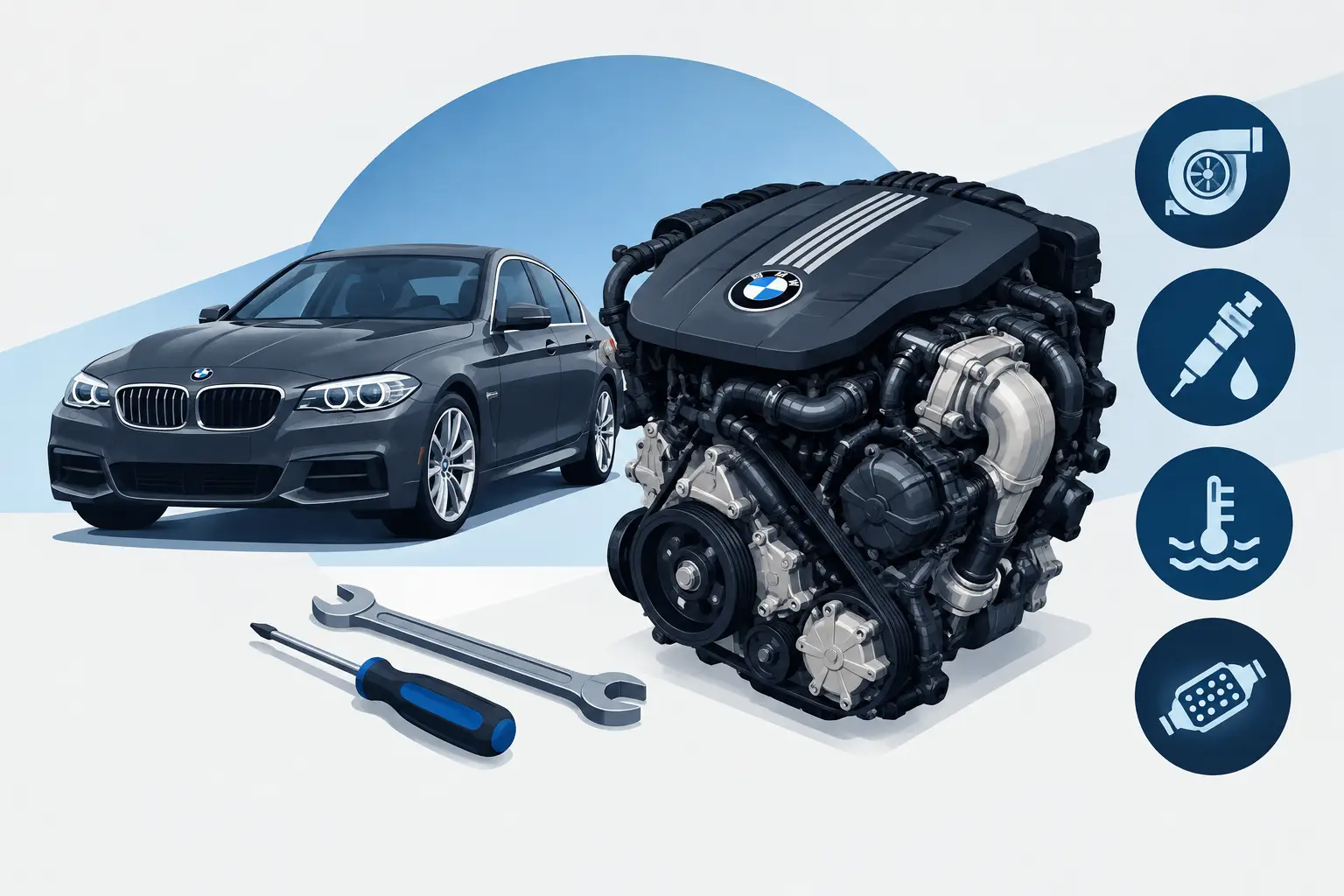
A healthy BMW N57 is a strong, refined 3.0-liter diesel capable of serious mileage and effortless torque. But BMW N57 common problems can become expensive when early warning signs are ignored, particularly on cars used for short trips or serviced inconsistently. Knowing which faults are repairable around the engine and which point to internal damage helps owners, workshops, and trade buyers make a sensible decision before approving a major bill.
The N57 appeared in a wide range of BMW models, including selected 3 Series, 5 Series, 6 Series, 7 Series, X3, X5, and X6 diesel applications. Versions include single-turbo, twin-turbo, and higher-output tri-turbo configurations, so the engine code, power rating, emissions equipment, and VIN must all be checked before ordering parts or a replacement assembly.
Timing chain wear is the N57 concern most owners want assessed first. The chain system is mounted at the rear of the engine, on the transmission side, making access labor-intensive even before replacement parts are considered. A metallic rattle from the rear of the engine, especially at cold start or idle, is a reason to stop guessing and have the timing system inspected.
Chain trouble is not confined to one mileage point. Oil change intervals, oil quality, previous repair history, and how the vehicle has been driven all matter. As chain stretch or guide wear progresses, timing can move out of specification. In the worst case, a chain failure can allow piston-to-valve contact and turn a service repair into an engine replacement decision.
Do not assume every diesel rattle is a timing chain, but do not dismiss a persistent noise either. A BMW specialist can assess fault codes, oil condition, engine timing values, and mechanical noise before recommending work. Catching the issue early can protect the cylinder head, valves, and bottom end.
The exhaust gas recirculation system is essential to emissions control, but it operates in a harsh environment of soot, heat, and oil vapor. Carbon buildup can restrict the EGR valve, causing rough running, reduced power, warning lights, or poor throttle response. A failed or leaking EGR cooler can create more serious concerns, including coolant loss, exhaust smell, and in certain circumstances a fire risk.
EGR campaigns and recall actions have applied to some BMW diesel models, but eligibility depends on the individual vehicle and market. Check the VIN with an authorized BMW source rather than relying on internet lists. If there is unexplained coolant loss, visible staining around the EGR system, or a strong exhaust odor, the vehicle should be inspected promptly.
Removing or bypassing emissions equipment is not a repair. It can create legal, inspection, and reliability problems, while masking the fault that needs correcting.
A diesel particulate filter needs regular successful regeneration to clear accumulated soot. N57-powered BMWs used mainly for urban trips may not reach the exhaust temperatures required to complete that process. The result can be frequent regeneration requests, reduced performance, increased fuel consumption, limp mode, or a DPF warning light.
The filter itself is not always the root cause. Faulty temperature or pressure sensors, an EGR problem, boost leak, injector imbalance, thermostat fault, or an engine that never reaches proper operating temperature can all prevent normal regeneration. Replacing a DPF without diagnosing why it loaded up may lead to the same problem returning.
Oil dilution is also worth taking seriously. Repeated interrupted regenerations can allow fuel to contaminate the engine oil. If the oil level rises or smells strongly of diesel, arrange an inspection and oil service without delay. Continued driving on diluted oil can accelerate wear in the turbocharger and internal engine components.
The N57 range uses sophisticated turbocharging systems to deliver high torque at low rpm. Depending on the version, this may be a single, sequential twin-turbo, or tri-turbo arrangement. That performance comes with more hoses, actuators, vacuum controls, and charge-air components that need to remain in good condition.
A split intercooler hose, sticking actuator, vacuum leak, worn turbocharger, or boost control fault can produce similar symptoms: loss of power, whistling, excess smoke, underboost or overboost codes, and limp-home mode. Oil in the intake tract deserves proper assessment. A light oil film can be normal on a turbo diesel, while excessive oil, smoke, or rapidly falling oil level may point to a more significant turbo issue.
On higher-output N57 variants, exact fitment matters even more. Turbos, manifolds, pipework, electronics, and calibration can differ across model years and power outputs. Use the engine code and VIN, not just the model badge, when sourcing replacement components.
Soot from the EGR system combines with oil vapor in the intake and can build up over time. Restricted intake ports or a heavily contaminated inlet manifold can affect airflow, response, fuel economy, and emissions performance. This is particularly common on vehicles that spend most of their lives at low speed.
The intake manifold on many N57 engines also uses swirl flap mechanisms. Wear, linkage issues, and actuator faults can generate codes or performance problems. The right response depends on the condition of the manifold, actuator, and intake tract as a whole. A thorough inspection is more useful than replacing one component based solely on a generic fault code.
Hard starting, uneven idle, diesel knock, excessive smoke, or a misfire-like sensation can indicate an injector or fuel delivery issue. Injector correction values, fuel pressure readings, return-flow testing, and fuel contamination checks help narrow down the fault. A poor injector can also contribute to DPF loading and combustion problems, so it should not be treated as an isolated inconvenience.
High-pressure fuel system failures are less common than timing, EGR, or DPF concerns, but they can be costly if metal contamination spreads through the system. If a vehicle has poor fuel pressure, starting trouble, or evidence of contaminated fuel, avoid repeated cranking and have it diagnosed professionally.
The best choice depends on what has actually failed. An EGR valve, boost hose, thermostat, sensor, intake cleaning service, or properly diagnosed DPF repair may be a practical way to keep an otherwise healthy N57 on the road. Even timing chain work can make sense when compression is good, oil quality is acceptable, and there is no evidence of internal damage.
A replacement engine becomes more attractive after a broken timing chain, piston or valve damage, severe overheating, low compression, excessive crankcase pressure, bearing damage, or a turbo failure that has led to major oil ingestion. In those situations, rebuilding the original unit can involve uncertain labor costs and a longer vehicle downtime.
For an owner or repair shop, a carefully sourced used N57 engine can provide a more controlled route back to service. The engine should be matched by VIN, engine code, turbo configuration, emissions specification, and transmission application. It is also wise to discuss whether ancillaries are included. Injectors, turbos, manifolds, wiring, sensors, and pumps may need to be transferred from the original engine or supplied separately, depending on the assembly specification.
BAV Engines supports this process with BMW-specific fitment assistance, helping buyers identify a compatible replacement rather than relying on displacement alone. A professionally inspected, low-mileage donor engine with clear condition information gives workshops and owners a stronger starting point for an economical repair.
The N57 rewards preventative maintenance more than optimistic servicing. Use the correct approved oil, change it on a sensible schedule for the vehicle’s use, and investigate oil level changes rather than simply topping it up. Let the engine warm up before heavy load, but avoid long periods of unnecessary idling.
If the car mainly covers short trips, give it regular longer drives where safe and practical so it can reach operating temperature and complete regeneration. Address warning lights, coolant loss, boost leaks, and unusual noises early. Waiting for a small fault to become a breakdown is where an affordable repair often becomes a major engine bill.
Before committing to a repair or replacement, ask for a diagnosis that explains the evidence: fault codes, compression results where relevant, oil condition, cooling-system findings, and the state of the turbo and timing system. That information turns a difficult N57 decision into a clear plan for getting the BMW back on the road with confidence.