Our Location
304 North Cardinal St.
Dorchester Center, MA 02124
Plan an S55 engine replacement with fitment checks, donor inspection details, cost factors, and practical advice for BMW M2, M3, and M4 owners worldwide.
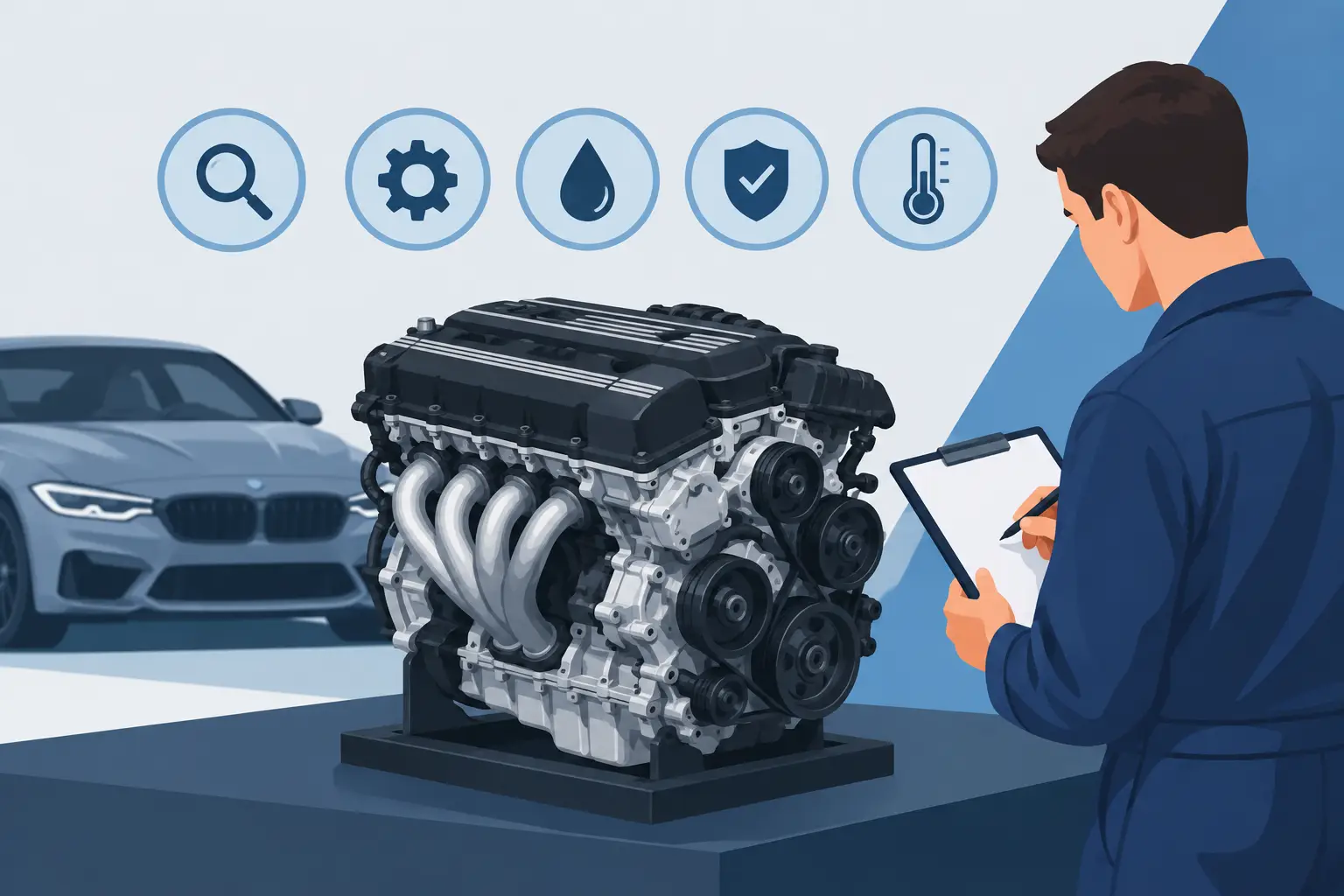
An S55 engine replacement is a major decision, but it does not have to mean the end of your BMW M car. A carefully sourced used S55 can restore the performance, drivability, and factory character of an F80 M3, F82 or F83 M4, or F87 M2 Competition at a far more realistic cost than a new factory assembly. The key is confirming the real cause of failure, selecting the correct donor engine, and avoiding shortcuts during installation.
The BMW S55 is a 3.0-liter twin-turbocharged inline-six built for serious performance. Found in the F80-generation M3, F82/F83 M4, and later F87 M2 Competition and M2 CS models, it delivers strong power from a compact, high-revving package. It is also a complex M engine with direct injection, twin turbochargers, advanced cooling, VANOS variable valve timing, and sensitive electronic management.
Replacement becomes the sensible route when the existing engine has suffered internal damage that cannot be repaired economically. A spun bearing, damaged crankshaft, cracked block, severe overheating event, piston damage, or major timing-related failure can quickly turn a rebuild into an expensive and uncertain project. If the engine has excessive metal contamination throughout the oil system, replacing only the visibly damaged parts may leave the vehicle vulnerable to another failure.
That said, not every rough-running S55 needs a complete engine. Misfires can come from ignition coils, spark plugs, injectors, fuel pressure faults, boost leaks, or wiring issues. Smoke may relate to turbocharger seals, the PCV system, or oil consumption rather than a failed short block. A proper diagnosis before purchasing an engine protects the budget and prevents replacing a serviceable powertrain.
For a workshop, diagnosis should include fault-code scanning, compression or leak-down testing where appropriate, oil-pressure assessment, inspection of drained oil and filter media, and a check for coolant or oil contamination. If the engine has been dismantled, evaluate the crankshaft, rod bearings, cylinder walls, and timing components before deciding whether repair or replacement is the better value.
An S55 is not simply an S55. While the core engine family is shared across several M models, the complete assembly can differ by production date, emissions configuration, software calibration, accessory equipment, plumbing, sensors, and transmission-related components. The safest purchase is the one confirmed against the vehicle VIN, engine code, and build specification.
The F80 M3 and F82/F83 M4 use S55 variants produced across multiple model years. The F87 M2 Competition and M2 CS also use the S55, but their installation details and calibration requirements must be checked carefully. A donor engine may physically fit while requiring the transfer of specific original parts from the failed unit, such as the engine wiring harness, sensors, sump-related parts, intake components, turbo plumbing, or ancillary brackets.
Transmission choice matters as well. Cars equipped with a six-speed manual and those fitted with the seven-speed M DCT can have different supporting components around the engine and drivetrain. A reputable supplier should help identify whether you need a bare long block, a dressed engine, or a more complete assembly with major accessories included.
Before ordering, have these details ready:
These details reduce the risk of buying an engine that looks correct in photos but creates delays once it reaches the installer.
A low-mileage donor engine can offer excellent value, but mileage is only one part of the condition picture. The more useful question is whether the engine has been carefully sourced and professionally inspected before sale. A high-performance BMW engine should be evaluated for mechanical condition, visible damage, lubrication quality, and signs of prior overheating or poor maintenance.
At minimum, the donor should be checked for clean, uncontaminated oil, obvious bearing material, external cracks, broken mounting points, damaged threads, and signs of impact damage from the donor vehicle. Inspection should also consider the condition of the valve cover area, cooling connections, turbocharger housings, intake ports, and wiring connectors where included.
Compression results can be helpful when documented, although testing methods and the engine’s removal status can affect readings. Consistency between cylinders often matters more than chasing a single number without context. If the engine is supplied with turbochargers, inspect them for shaft play, damaged compressor wheels, oil leakage, and cracked or loose housings. If turbos are not included, confirm that clearly before pricing the job.
A used S55 should also be assessed with realistic expectations. It is not a zero-mile factory engine, and no responsible seller should present it as one. The objective is a tested, quality replacement assembly with known fitment support and warranty options, giving the owner a practical route back to reliable M-car performance.
Installing the replacement engine is where a good purchase can either pay off or become costly. If the original S55 failed internally, the surrounding systems must be treated as part of the repair. Reusing contaminated components can send metal particles into the replacement engine and cause damage shortly after startup.
Oil coolers, oil lines, the oil filter housing, turbocharger oil-feed and return lines, and related lubrication components require careful assessment. Depending on the type of failure, replacement may be safer than flushing. The charge-air system also deserves attention if a turbocharger failure sent oil or debris through the intake tract. Intercoolers, boost pipes, intake plumbing, and catalytic converter condition should be checked before the new engine is put under load.
Cooling-system health is equally important. Replace weak hoses, inspect the radiator and expansion tank, verify coolant flow, and make sure the electric water pump and thermostat are operating correctly. An engine replacement is also the right time to inspect engine mounts, belts, pulleys, vacuum lines, and any hard-to-reach seals. Spending a little more on sensible preventative work while access is open can prevent a second major labor bill later.
After installation, use the correct BMW-approved fluids, prime the lubrication system as required by the repair procedure, clear stored faults, and perform the necessary adaptations or coding. The engine control unit normally remains with the vehicle, but all transferred sensors, harnesses, and modules must be correct and connected properly. A careful initial heat cycle and road test are essential before returning the vehicle to normal use.
The purchase price of the replacement engine is only one part of the project. A complete S55 with tested turbos and accessories may cost more upfront than a basic long block, yet it can reduce the need to reuse questionable components. On the other hand, an experienced BMW specialist may prefer a long block when the original turbos, fuel system, and external equipment have been inspected and proven serviceable.
Labor varies substantially by shop location, transmission type, the extent of the original damage, and how many supporting parts need replacement. An engine that comes with matching accessories and verified fitment can shorten turnaround time, while an incorrectly specified donor can create costly delays. Shipping, warranty coverage, and international delivery requirements should also be considered before committing to a purchase.
For owners comparing replacement against rebuilding, the decision depends on parts availability, machine-shop condition, and the state of the original core. A rebuild can make sense when damage is limited and the block, crankshaft, and cylinder head are within specification. A replacement engine is often the more predictable option when there is widespread internal damage or the vehicle needs to return to the road quickly.
A generic used-engine listing may provide a price and a stock photo. That is not enough for an S55 project. Look for a supplier that can verify fitment using the VIN or engine code, explain exactly what is included, describe donor mileage where available, and provide clear information on inspection and warranty options.
BAV Engines focuses on BMW powertrains and can help buyers identify a suitable used S55 assembly for the vehicle specification rather than relying on a broad compatibility claim. That support matters to private owners who need reassurance and to independent shops managing repair time, customer expectations, and installation risk.
The right S55 replacement is not just the engine that arrives first. It is the assembly that matches the car, has been inspected for quality and reliability, and is installed alongside the repairs needed to protect it. Get those details right, and your M3, M4, or M2 Competition can return to the road with the response and performance that made you choose an M car in the first place.