
Our Location
304 North Cardinal St.
Dorchester Center, MA 02124
BMW hybrid engine replacement starts with correct diagnosis, VIN-based fitment, and a tested donor assembly that restores reliable performance and value.
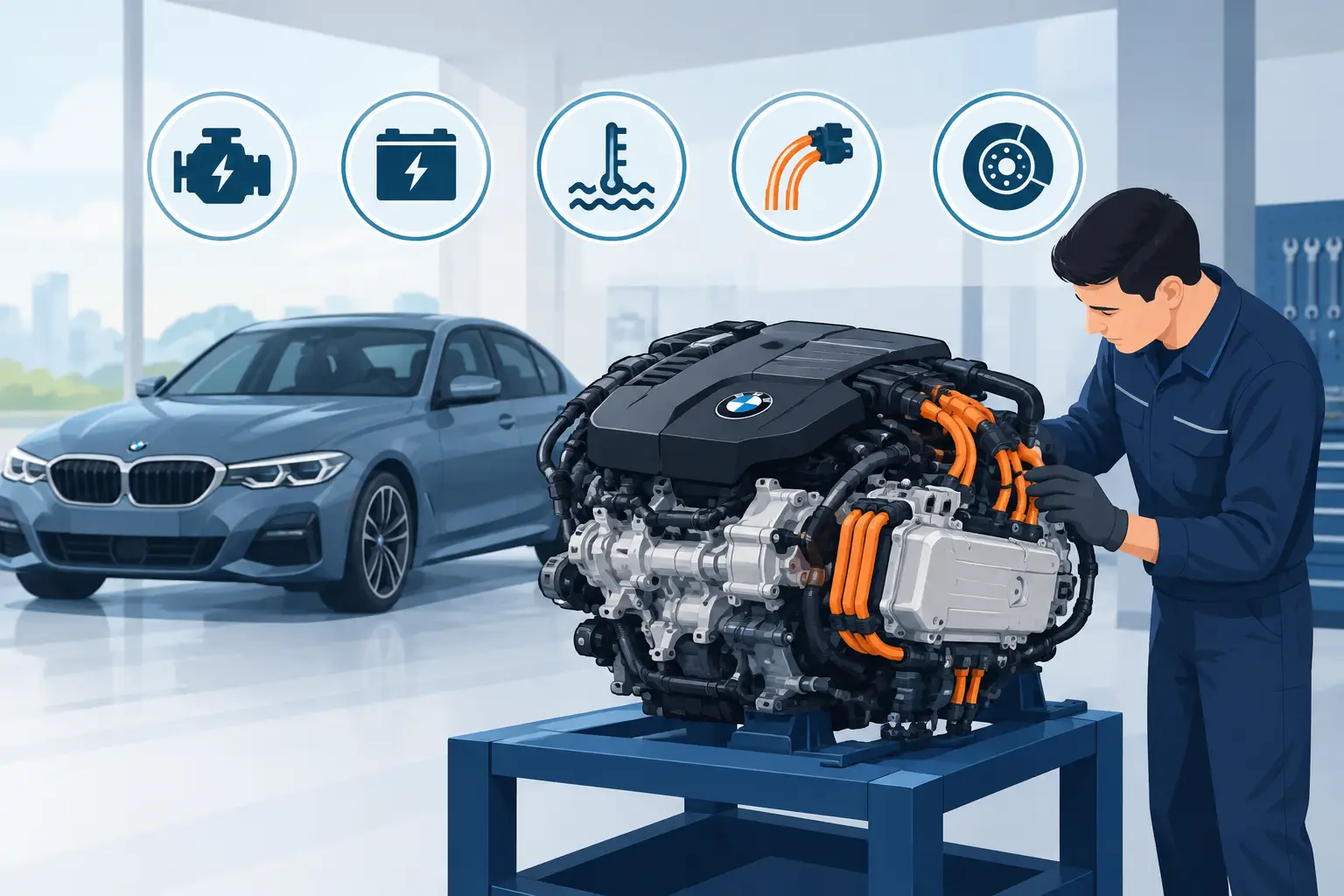
A BMW hybrid engine replacement is rarely as simple as fitting another gasoline engine and turning the key. Plug-in hybrid BMWs combine an internal-combustion engine with high-voltage components, electric drive hardware, cooling circuits, and model-specific control systems. When the gas engine has suffered overheating, low compression, timing damage, oil starvation, or severe internal wear, the replacement must match the vehicle correctly while the hybrid system is assessed separately.
For owners of a 330e, 530e, 740e, X3 xDrive30e, X5 xDrive45e, or similar model, the right used engine can be the practical alternative to a costly new factory unit. The key is confirming what has actually failed before ordering parts. A hybrid warning message, reduced power condition, or no-start fault does not automatically mean the engine itself needs replacement.
Hybrid BMWs can conceal an engine problem for longer than a conventional vehicle because the electric motor may continue to move the car at low speeds. That does not make a mechanical issue less serious. A noisy timing chain, coolant loss, bearing knock, excessive oil consumption, or a cylinder with poor compression still requires prompt attention.
A proper diagnosis should separate internal-combustion faults from high-voltage faults. Compression and leak-down testing can help identify valve, piston-ring, or head-gasket damage. Oil inspection may reveal metallic debris, coolant contamination, or signs of bearing failure. Checking the cooling system for pressure loss, combustion gases, and leaks is equally important, particularly after an overheating event.
Electronic fault codes also matter, but they must be interpreted in context. A misfire code may result from an injector, ignition coil, wiring issue, or mechanical compression loss. Likewise, reduced drivetrain power can originate from the hybrid battery, electric motor, transmission, or gas engine. Replacing a healthy engine will not solve a failed high-voltage component.
In most cases, a replacement engine means the gasoline engine assembly, not the entire hybrid drivetrain. The electric motor on many BMW plug-in hybrids is integrated into or positioned alongside the transmission, while the high-voltage battery is mounted elsewhere in the vehicle. These components are not normally included with a used engine assembly.
The exact configuration depends on the platform and production year. Some BMW hybrids use four-cylinder turbocharged engines, while larger models may use six-cylinder turbocharged units. A 330e and 530e commonly use variants of BMW’s 2.0-liter turbocharged four-cylinder architecture, whereas certain X5 and 7 Series plug-in hybrid models use six-cylinder engines such as the B58-based setup.
That distinction matters because two engines with similar displacement may have different accessories, wiring provisions, exhaust hardware, cooling connections, sensors, engine mounts, or software requirements. An engine from a conventional gasoline BMW may be physically related to a hybrid application, but it should never be assumed to be a direct fit without checking the engine code and VIN details.
A professionally sourced replacement is usually supplied as a long block or complete engine assembly, depending on available inventory. Before purchase, confirm what is included. Intake components, turbochargers, fuel injectors, manifolds, alternators, air-conditioning compressors, wiring harnesses, and hybrid-specific accessories may need to be transferred from the original engine or sourced separately.
“BMW 530e engine” is not enough information to order with confidence. BMW can use different engine revisions across production years, markets, emissions standards, and drivetrain layouts. The VIN is the most reliable starting point because it identifies the original specification fitted to the vehicle.
A supplier or technician should check the VIN, production date, engine code, transmission type, and whether the vehicle is a plug-in hybrid or a 48-volt mild hybrid. Mild-hybrid BMWs also have electrical components that affect service work, but they are different from high-voltage plug-in hybrid systems.
For the best result, compare the original engine number or engine code where available. Then verify the cylinder head configuration, turbo arrangement, fuel system, sensor locations, and accessory mounting points. This approach prevents a common and expensive problem: receiving a mechanically similar engine that requires extensive conversion work or cannot communicate correctly with the vehicle’s existing systems.
BAV Engines supports this process by matching available replacement engines against VIN, registration, and engine-code information before an order is finalized. It is a simple step that can save a garage hours of unexpected labor and prevent the wrong engine from being shipped across the country or overseas.
A used BMW engine should be selected on condition, not price alone. Low donor mileage is useful, but it is only one part of the picture. A carefully sourced engine should be professionally inspected for visible damage, oil condition, signs of overheating, excessive wear, and mechanical integrity.
For turbocharged BMW engines, pay close attention to the turbocharger condition if it is included. Shaft play, oil residue, damaged housings, and contaminated intake plumbing can point to a problem that should be resolved before installation. On engines with known timing-system concerns, ask whether the timing components have been inspected and whether there is any evidence of chain noise or guide wear.
Compression testing is particularly valuable when available because it provides a practical indication of cylinder sealing. It does not replace a full teardown, but it offers more confidence than buying an untested assembly. A clean oil system, intact cooling passages, undamaged threads, and no obvious cracks or impact damage are equally relevant.
A quality supplier should explain the warranty options, the condition standard used for the engine, and the delivery process. This gives private owners and repair shops a clearer basis for comparing a tested used engine against a cheap unknown unit with no inspection history.
Replacing the gas engine in a plug-in hybrid BMW is a job for a workshop familiar with both BMW mechanical systems and high-voltage safety procedures. Before work begins, the vehicle’s high-voltage system must be shut down and secured according to the correct manufacturer procedure. Orange high-voltage cables, battery connections, and related components should only be handled by appropriately qualified personnel.
The installation itself also requires more than dropping in the engine. The technician should inspect the engine mounts, cooling hoses, charge-air system, fuel lines, exhaust connections, and wiring before reassembly. Reusing a failed component can compromise the replacement engine. For example, an overheating failure may have been caused by a water pump, thermostat, radiator restriction, coolant leak, or cooling-control issue that must be corrected first.
Once installed, the vehicle may require software programming, fault-code clearing, adaptation resets, and a careful road test. Cooling systems must be bled correctly, engine oil and filters renewed, and all fluid levels confirmed. A post-install scan is especially useful on hybrid models because it verifies communication between the engine control unit, hybrid electronics, and transmission.
Engine replacement often makes sense when the BMW is otherwise in good condition, the hybrid battery and drivetrain have tested well, and the cost of rebuilding the original engine is disproportionate. A used, inspected engine can preserve a vehicle that still has strong value, a clean interior, sound chassis condition, and years of useful service ahead.
It may be less attractive when there are multiple major faults at once, such as a damaged engine plus a failing high-voltage battery, transmission problems, or severe accident damage. That does not automatically rule out repair, but the total estimate should be compared with the vehicle’s market value and the owner’s plans for keeping it.
For many owners, the deciding factor is not simply the lowest repair bill. It is the confidence that the replacement engine is correctly matched, tested for quality and reliability, and installed after the original cause of failure has been addressed. Get the diagnosis right first, verify fitment with the VIN, and a well-chosen BMW hybrid engine can put a valuable vehicle back on the road without the cost of a new factory powertrain.