
Our Location
304 North Cardinal St.
Dorchester Center, MA 02124
Compare remanufactured versus used MINI engines by cost, condition, fitment, and warranty to choose the right replacement for your MINI before buying.
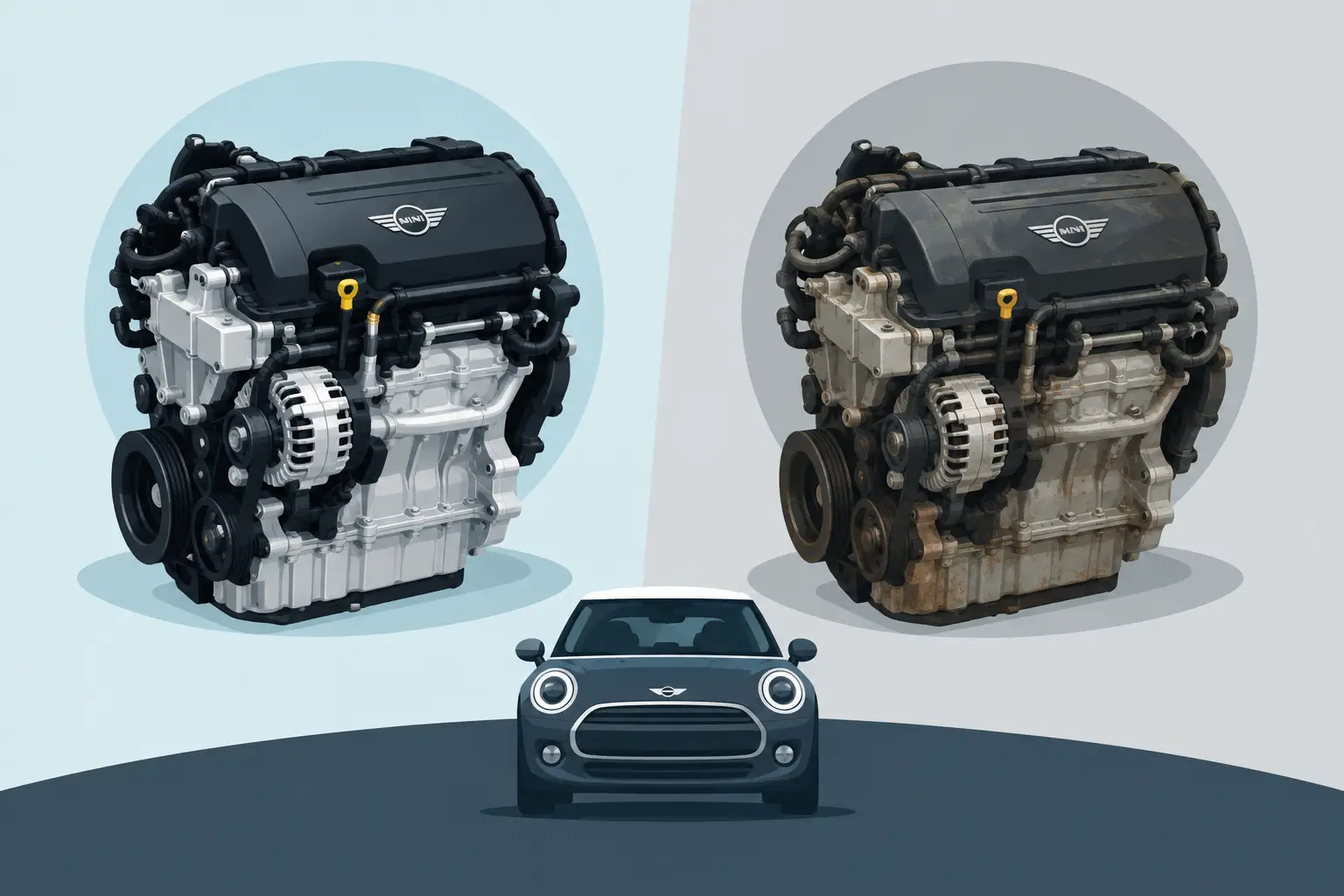
A failed MINI engine creates a decision that is bigger than simply finding a replacement. The real choice is often remanufactured versus used MINI engines: pay more for an engine rebuilt with new internal components, or choose a carefully sourced donor engine that can return the car to the road for less. Neither route is automatically right for every MINI. The best option depends on the failure, your vehicle’s age and value, the required turnaround time, and whether correct fitment has been confirmed before the engine is ordered.
For owners of a Cooper, Cooper S, Clubman, Countryman, or John Cooper Works model, the details matter. MINI engines vary significantly across generations, from earlier N12, N14, N16, and N18 units to modern B38 and B48 engines. A replacement that appears similar can still have differences in turbocharger specification, sensors, wiring, emissions equipment, timing components, or transmission compatibility.
A remanufactured engine is an engine that has been dismantled, cleaned, measured, and rebuilt to a specified standard. During the process, worn or damaged internal components may be machined or replaced. Depending on the remanufacturer and the package offered, this can include bearings, piston rings, seals, gaskets, timing components, oil pumps, and valve-train parts.
The main attraction is predictability. A properly remanufactured MINI engine is intended to provide a fresh mechanical starting point, particularly where the original engine has suffered severe overheating, low compression, bearing damage, oil starvation, or a major timing failure. For a workshop managing a customer repair, a reman unit can also simplify the conversation around internal wear because the engine has been rebuilt rather than removed from another vehicle in operating condition.
That said, the word “remanufactured” does not mean every supplier provides the same scope of work. One engine may be a fully rebuilt long block, while another may have limited machining and replacement parts. Some units are supplied without the turbocharger, fuel system, intake manifold, or ancillary components. Before buying, establish exactly what is included, what has been replaced, whether the cylinder head and block have been tested, and what warranty terms apply.
Remanufactured engines are typically the higher-cost option. In some cases, that investment makes complete sense, especially for a newer MINI, a low-mileage vehicle in excellent condition, or a project where long-term ownership is the priority. But a rebuild does not remove the need for professional installation. Cooling-system faults, contaminated oil lines, a failed turbo oil feed, injector problems, or incorrect engine programming can damage even a newly remanufactured unit.
A used MINI engine is a complete or partial engine assembly removed from a donor vehicle. It has not been rebuilt from the ground up, but a quality supplier should carefully source it and inspect its mechanical condition before sale. This route gives buyers an OEM-origin engine with the original factory engineering, usually at a substantially lower purchase price than a remanufactured alternative.
The value of a used engine comes down to the donor and the checks completed before it is offered for sale. Low donor mileage is useful, but mileage alone is not a condition report. An engine with a sensible mileage history and clean oil may be a stronger choice than a supposedly lower-mileage unit with signs of overheating, sludge, impact damage, or poor maintenance.
A professionally inspected used MINI engine should be assessed for visible wear, oil quality, compression where appropriate, mechanical rotation, leaks, damage to mounting points, and overall condition. The exact inspection process can vary by engine type and the condition in which it arrives from the donor vehicle. Buyers should also ask whether the engine is supplied as a bare long block or as a more complete assembly with items such as the cylinder head, sump, injectors, turbocharger, manifolds, or accessories.
For many owners, a used engine is the practical answer when the car needs to be back on the road without absorbing the cost of a factory replacement or a full remanufactured build. This is particularly true for older R50, R53, R55, R56, R57, R58, R59, R60, and R61 MINIs where the repair budget must remain sensible in relation to the vehicle’s current value.
The purchase price is usually the first difference buyers notice. A remanufactured engine costs more because rebuilding requires labor, machining, replacement components, testing, and administration. A used engine generally costs less because it is an inspected donor assembly rather than a newly rebuilt product.
However, the engine price should never be viewed on its own. Engine replacement labor, fluids, filters, belts, hoses, gaskets, cooling-system repairs, coding, and diagnostic work all contribute to the final invoice. If a MINI has a known weak point that is accessible only while the engine is out, such as a clutch, timing assembly, water pump, thermostat housing, turbo oil lines, or crankshaft seals, it may be cost-effective to address it during installation.
A used engine can offer the strongest value where the donor unit is carefully sourced, mechanically inspected, correctly matched, and supplied with warranty options. It can make the difference between repairing a sound vehicle and deciding that the repair is uneconomical. A remanufactured engine may offer better value where the owner plans to keep the MINI for years and accepts a higher upfront cost for renewed internal components.
The right question is not, “Which engine is cheapest?” It is, “Which engine gives this particular MINI a reliable repair at a cost that makes sense?”
MINI engines can look alike across model years while carrying meaningful differences. A Cooper S engine with an N14 code is not simply interchangeable with every N18 Cooper S engine. The later B38 three-cylinder and B48 four-cylinder families also require accurate identification, particularly across F-series and newer MINI platforms.
Before ordering either a remanufactured or used engine, confirm the VIN, registration information, engine code, fuel type, model year, transmission type, and whether the vehicle is turbocharged. A MINI Countryman All4 may have different requirements from a front-wheel-drive hatchback, even when the listed engine displacement appears identical. Emissions configuration and market specification can also matter for US, UK, and international vehicles.
A complete engine assembly may reduce parts-transfer time, but it still needs to be checked against the original unit. In many replacements, the installer will transfer selected external parts from the original engine to preserve vehicle-specific compatibility. This might include wiring looms, sensors, intake components, fuel equipment, engine mounts, or the ECU-related hardware. The required approach depends on the supplied engine and the vehicle it is going into.
BAV Engines supports fitment checks using vehicle and engine details so buyers can avoid the expensive mistake of ordering an engine that is close, but not correct. This is especially valuable for independent garages handling multiple MINI variants and for owners who do not know their engine code.
A remanufactured engine is generally the stronger option when the vehicle is newer, has strong resale value, or is part of a long-term ownership plan. It can also suit cars with extensive internal damage, where a buyer wants known rebuilt components rather than a donor engine of unknown service history.
It may be worth considering if your MINI has already had repeated engine-related issues and you are addressing the entire system at once. For example, after a serious oil starvation event, the repair should include more than the engine itself. The cause must be identified, the lubrication system must be cleaned or renewed as required, and related turbocharger components must be inspected. Installing any replacement engine without correcting the original cause risks repeating the failure.
A remanufactured unit is not necessarily the best choice for every older MINI. If the rest of the vehicle has high mileage, rust concerns, transmission issues, or significant suspension and electrical needs, a lower-cost used engine may be the more balanced repair decision.
A used engine is often the sensible choice when you need OEM-level compatibility, a lower replacement cost, and a faster route back to driving. It is particularly attractive when the existing MINI has been well maintained apart from a single engine failure, such as a cracked block, failed timing chain, excessive oil consumption, or compression loss.
The key is buying from a specialist that understands MINI applications rather than treating every engine as a generic used part. Ask about donor mileage, inspection standards, the exact assembly supplied, delivery arrangements, warranty availability, and fitment confirmation. A low-mileage, professionally inspected donor engine can provide dependable service without the price of a full rebuild.
Your installer also has a major role in the outcome. They should inspect the cooling system, renew service items where necessary, use the correct oil specification, prime the lubrication system where appropriate, complete required adaptations or programming, and road-test the vehicle after installation. A replacement engine deserves the same careful setup as any major mechanical repair.
Choose the engine that fits your MINI, your repair plan, and your budget – then make sure the original failure has been properly diagnosed before the first start-up. That is where a replacement engine becomes a lasting repair rather than a temporary fix.