Our Location
304 North Cardinal St.
Dorchester Center, MA 02124
BMW engine VIN compatibility check confirms engine code, emissions equipment, drivetrain, and electronics before you order a tested used replacement engine.
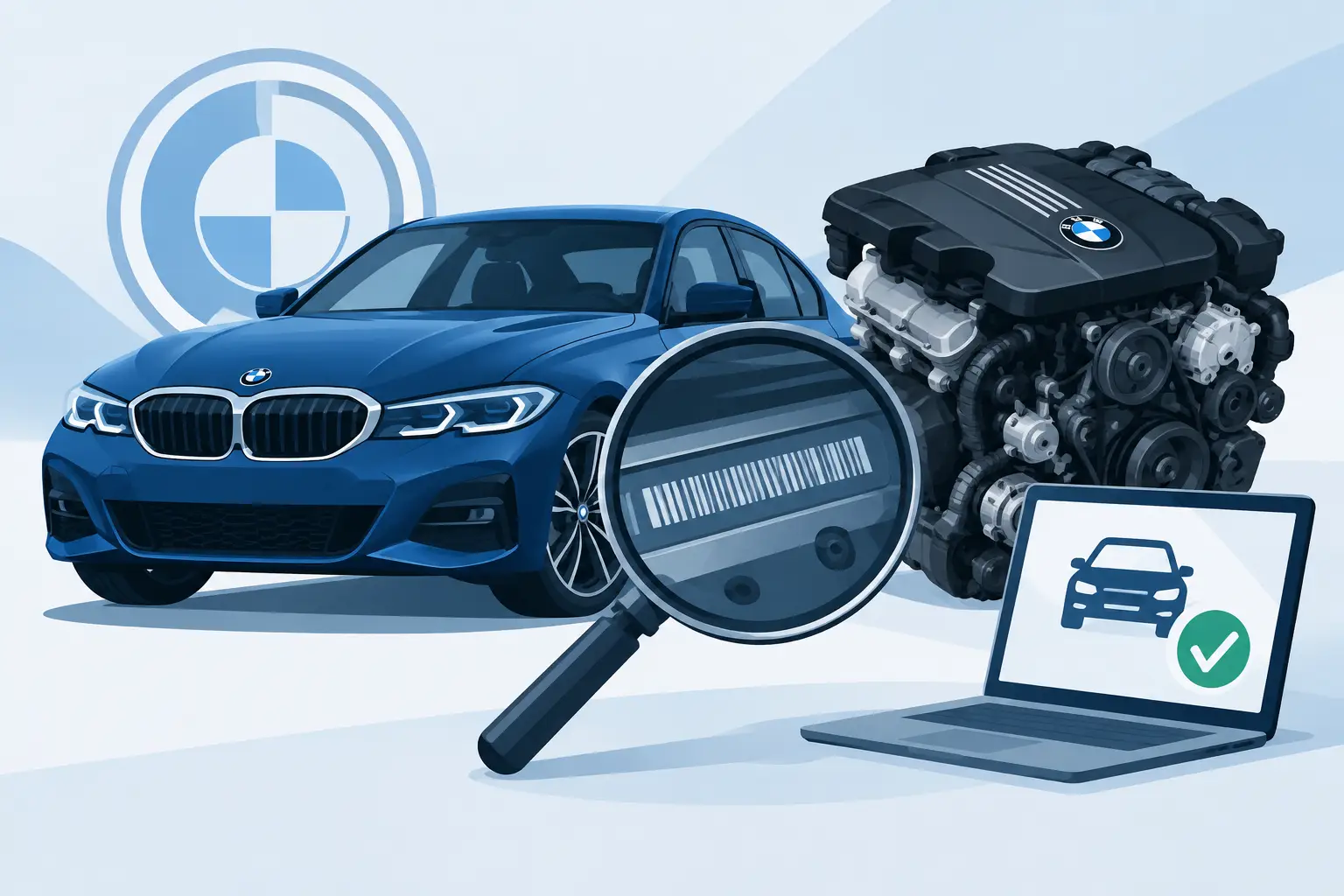
A replacement BMW engine can look correct on paper and still create expensive problems once it reaches the workshop. The same engine family may have different turbo systems, emissions hardware, oil pans, wiring, or control modules across model years and markets. A BMW engine VIN compatibility check is the practical step that prevents a costly incorrect order and helps get your vehicle back on the road with confidence.
For a private owner, the VIN gives a supplier the details needed to identify the correct replacement path. For a technician or independent garage, it provides a faster way to verify the engine code, production specification, drivetrain, and original equipment before labor begins. It is especially valuable with modern BMW diesel, turbocharged gasoline, hybrid-compatible, and M-series engines, where small specification differences matter.
A 17-character VIN identifies far more than the model badge on the trunk. It helps establish the vehicle’s build date, engine configuration, market specification, transmission, drive layout, and factory-installed options. Those details are used alongside the original engine code and vehicle registration to narrow down a suitable replacement.
For example, a BMW 3 Series may be listed as a 320d, but that description alone does not tell you whether it uses an N47 or B47 diesel engine, which power output was fitted, or whether the vehicle has rear-wheel drive or xDrive. An N47 from a similar-looking donor vehicle may not be a direct fit if its emissions equipment, ancillary layout, or electronic setup differs.
The same principle applies across the range. An N57 or B57 diesel engine can vary by single-turbo, twin-turbo, or high-output configuration. A B58 gasoline engine may have changes in cooling connections, fuel system components, and electronic integration between platforms. High-performance engines such as the S55, S58, and S63 require even closer verification because their specification is tied closely to the exact model and production period.
The engine code is one of the most useful identifiers in a replacement-engine search, but it is not the whole answer. BMW commonly develops an engine family over several years, fitting it to sedans, coupes, SUVs, and different international markets. A used engine can share the same basic code while carrying different bolt-on components or calibration requirements.
A complete engine assembly may include components such as the turbocharger, injectors, intake system, exhaust manifold, sensors, wiring sections, and accessories. Their suitability depends on the donor specification and how the engine is supplied. In many cases, the most reliable approach is to use the tested replacement long block while transferring certain original vehicle-specific parts, provided those components are in good mechanical condition.
This is why a compatibility check should clarify whether you need a complete engine, a bare engine, or a long block. A complete assembly can reduce workshop time when the donor is closely matched. A long block may be the more practical and cost-effective option when your original turbo, injectors, wiring, and accessories are known to be serviceable and must remain with the vehicle.
A proper fitment assessment considers the vehicle as a complete system, not just its displacement or fuel type. Before a replacement engine is selected, the supplier or workshop should compare the VIN data with the failed engine and the available donor assembly.
The key checks include:
These checks are especially important when buying for imported vehicles. A US-market BMW and an equivalent European-market vehicle may have meaningful emissions and electronic differences, even if both carry a similar engine designation. The VIN helps identify the original market specification so the correct questions can be asked before shipment.
The most common mistake is ordering by model year and engine size alone. A listing that says “2014 BMW 2.0 diesel engine” may cover several applications that are not interchangeable without transferring parts or making modifications. The vehicle may be a 320d, X3, or 520d, each with different packaging and equipment requirements.
Another issue involves engine revisions. Early and later N47 engines, for instance, may share the same family name but use changed components depending on the application. The same is true for M57 and N57 engines, where intake, turbocharging, oil sump, and wiring differences can affect installation planning.
BMW xDrive applications deserve particular attention. A donor engine from a rear-wheel-drive car can sometimes be used, but it may require the correct xDrive oil pan and associated parts from the original engine. That is not automatically a problem, but it must be identified before the purchase so the garage can price the work accurately and avoid delays.
Electronic compatibility is another area where assumptions cause trouble. Modern BMW engines depend on communication between the ECU, sensors, fuel system, transmission, and immobilizer systems. In many cases, retaining the original ECU and transferring the correct original components is the cleanest route. The exact approach depends on the engine supplied, the reason for failure, and what parts remain usable from the original unit.
Providing the VIN is the best starting point, but a few additional details make the process quicker and more accurate. Have the vehicle registration, the engine code from the engine label or block where available, and a clear description of the fault. If a workshop has already removed the engine, photos of the engine tag, turbo setup, and major external components can also help.
Be clear about what failed. An engine with timing chain damage may have a different replacement requirement than one affected by overheating, low oil pressure, or a cracked block. If the failure sent metal debris through the oil system or damaged the turbocharger, simply fitting another engine without addressing the root cause can put the replacement at risk.
A dependable supplier should also explain the condition of the donor engine. At BAV Engines, replacement BMW and MINI engines are carefully sourced and professionally inspected, with attention paid to mechanical condition, visible wear, oil quality, and the suitability of the assembly for the intended application. Ask what is included, whether warranty options are available, and whether the quoted engine has been verified against your vehicle details.
Performance engines reward precision. An S55 from an M3 or M4, an S58 from a newer M model, or an S63 V8 from an M5, M8, X5 M, or X6 M is not a purchase to make from a broad description alone. Turbo layout, cooling equipment, exhaust hardware, electronics, and model-specific accessories can all affect fitment and final cost.
The same applies to B58-powered vehicles. While the B58 is widely used across BMW platforms, the donor engine’s model application can determine what must be transferred from the original vehicle. A VIN check does not mean every component will be identical. It tells you where the differences are, allowing the engine order and installation plan to be made properly.
For garages, this improves turnaround time. For owners, it avoids paying for an engine that appears affordable but requires unexpected parts, coding work, or fabrication after delivery.
A used replacement engine is one of the most effective ways to restore a BMW without new-engine pricing, particularly when the donor has low mileage and has been tested for quality and reliability. But value only exists when the engine is right for the vehicle and the installation is planned around the exact specification.
Send the VIN before committing to an engine, confirm what assembly is being supplied, and discuss any parts that must be transferred from your original unit. A few minutes spent verifying fitment can protect your budget, reduce downtime, and give your BMW the best chance of returning to the road exactly as it should.